Unit 1 — Energy, Power, Units and Orders of Magnitude
Big idea. Energy is the amount of "stuff that can do work"; power is how fast it flows. A solar panel is rated in power (watts), sold by peak power (Wp), and judged by the energy (kWh) it delivers over its life. Almost every confusion in solar talk comes from mixing these up.
Learning objectives
After this unit you can:
- define energy (J, kWh, eV) and power (W) and convert between them;
- explain irradiance (W/m²), irradiation (kWh/m²), watt-peak (Wp) and efficiency;
- estimate the power of a cell, a module and sunlight on Earth using powers of ten;
- spot the classic "kW vs kWh" error.
Why this matters
Every number in a solar factory is an energy or power number: a flash tester reports a module's Pmax in watts; the line's output is counted in MW or GW per year; polysilicon plants are judged on kWh per kilogram; efficiency is watts out per watt of sunlight in. If the units are wrong, every later calculation is wrong.
Energy: the currency
Energy is the capacity to do work — to push something, heat something, or move charge through a circuit. Its SI unit is the joule (J). One joule is the work done by a force of one newton over one metre — about the energy needed to lift an apple (≈100 g) one metre.
Energy comes in many forms (motion, heat, chemical bonds, light, electric potential) and is conserved: it is never created or destroyed, only converted. A solar cell does not "make" energy; it converts the energy of light into electrical energy, and the rest becomes heat or is reflected.
Three energy units you will use constantly:
| Unit | Size | Where it appears |
|---|---|---|
| joule (J) | SI base unit | physics equations |
| kilowatt-hour (kWh) | 1 kWh = 1000 W × 3600 s = 3.6 × 10⁶ J | electricity bills, factory energy use, module energy yield |
| electron-volt (eV) | 1 eV = 1.602 × 10⁻¹⁹ J | energy of a single photon or electron; band gaps |
The electron-volt is the energy an electron gains moving through a 1-volt potential difference. It is tiny, which is exactly why it is useful at the scale of one atom or one photon: silicon's band gap is 1.12 eV, a visible photon carries about 2–3 eV.
Power: the rate
Power is energy per unit time:
In words: power is how fast energy flows. A 60 W lamp uses 60 joules every second. Run it for one hour and it uses 60 W × 3600 s = 216,000 J = 0.06 kWh.
For electricity, power is voltage times current:
A solar cell at its best operating point might deliver about 0.6 V at 13 A — about 8 W. Voltage is the "push" per unit charge (joules per coulomb); current is the flow of charge (coulombs per second); multiply them and the coulombs cancel, leaving joules per second.
Power per area: irradiance
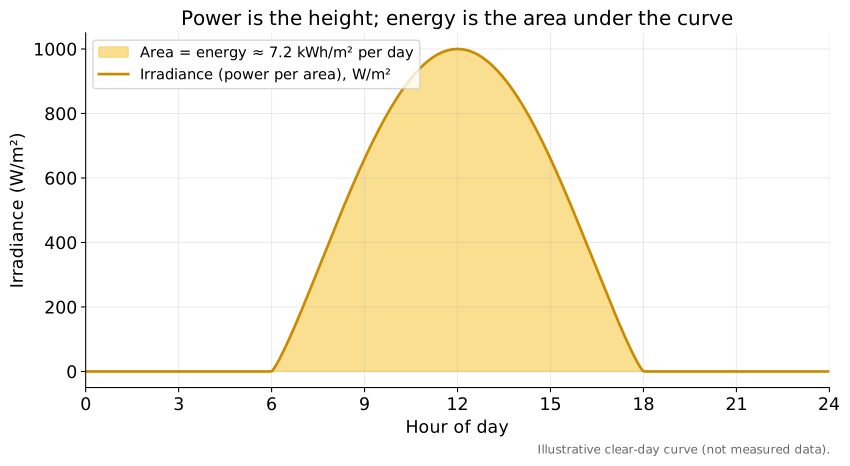
Sunlight is spread over area, so solar engineers use irradiance, power per unit area, in W/m². Bright midday sunlight on a surface facing the Sun is roughly 1000 W/m² — that is why 1000 W/m² was chosen as the standard test irradiance (Unit 10). Above the atmosphere the figure is about 1361 W/m² (Unit 6).
Integrate irradiance over time and you get irradiation (also called insolation), energy per area, in kWh/m² (per day or per year). A location receiving "5 kWh/m² per day" receives the same energy as 5 hours of 1000 W/m² sunlight — hence the informal term "peak sun hours".
Watt-peak and efficiency
A module's nameplate rating in watt-peak (Wp) is its maximum electrical power under standard test conditions (STC: 1000 W/m², AM1.5G spectrum, cell temperature 25 °C). It is a power under a defined condition, not an energy and not a guarantee of output outdoors.
Efficiency is simply output power divided by input power:
where \(G\) is the irradiance (W/m²) and \(A\) the area (m²). In words: of the sunlight landing on the device, what fraction comes out as electricity?
Worked example 1 — module efficiency
A module measures 1.134 m × 2.278 m and is rated 580 Wp at STC. Its area is \(A = 1.134 \times 2.278 = 2.583\ \text{m}^2\). Input power at STC is \(1000 \times 2.583 = 2583\) W. Efficiency \(= 580/2583 = 0.225\), i.e. 22.5 %. (Dimensions are typical of a current 144-half-cell module built from 182-mm wafers; the rating is an illustrative value in the range of today's TOPCon products.)
Worked example 2 — one cell
A 182 mm × 182 mm cell has area ≈ 0.0331 m² (ignoring the clipped corners). At 25 % efficiency under 1000 W/m²: \(P = 0.25 \times 1000 \times 0.0331 \approx 8.3\) W. At about 0.6 V, that is roughly \(8.3/0.6 \approx 14\) A — big currents, which is why cells are cut in half and why ribbons and solder joints matter (SOL 304).
Energy from power: kW vs kWh
Energy = power × time. The single most common error in energy writing is to confuse kW (rate) with kWh (amount).
Worked example 3 — a day's energy
The 580 Wp module above sits in a place with 5 kWh/m² per day of irradiation on its plane (5 "peak sun hours"). Ideal energy \(= 0.580\ \text{kW} \times 5\ \text{h} = 2.9\) kWh per day. Real systems deliver less (temperature, wiring, inverter, soiling — often 10–20 % less; estimate).
Orders of magnitude
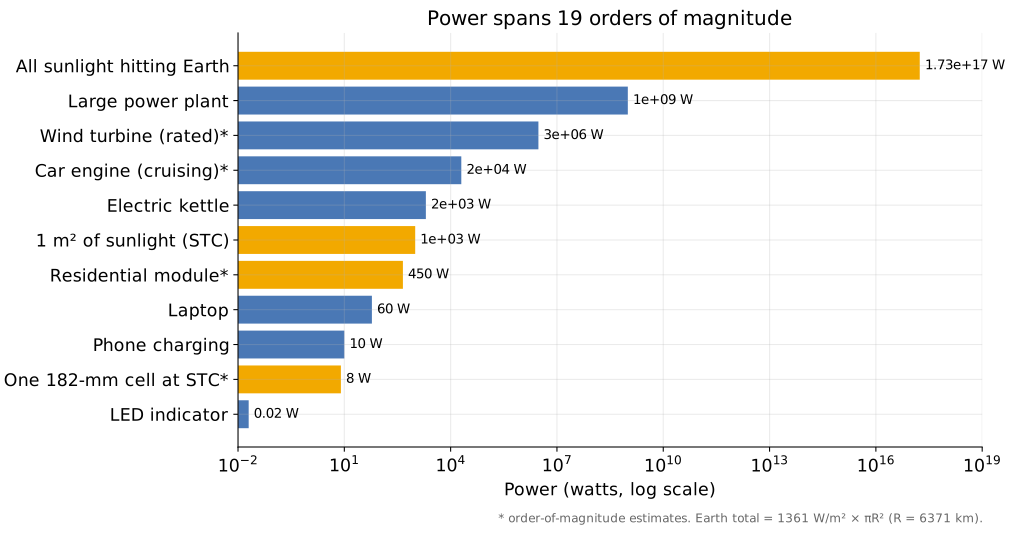
Physicists estimate first, then calculate. Powers of ten tell you whether an answer is plausible.
Worked example 4 — how big is the solar resource?
Earth intercepts \(\approx 1.7 \times 10^{17}\) W of sunlight. Average world primary energy use is of order \(2 \times 10^{13}\) W (≈ 20 TW; rough estimate from roughly 600 EJ per year ÷ 3.15 × 10⁷ s). Ratio ≈ 10⁴: the planet receives roughly ten thousand times more solar power than humanity uses. The resource is not the constraint; conversion, materials and manufacturing are — which is what this curriculum is about.
| Prefix | Symbol | Factor | Solar example |
|---|---|---|---|
| milli | m | 10⁻³ | mA/cm² (cell current density) |
| micro | µ | 10⁻⁶ | µm (wafer thickness ≈ 130 µm) |
| nano | n | 10⁻⁹ | nm (wavelength; SiNₓ coating ≈ 75 nm) |
| kilo | k | 10³ | kWh |
| mega | M | 10⁶ | MW (a solar farm) |
| giga | G | 10⁹ | GW (annual factory output) |
| tera | T | 10¹² | TW (world energy use) |
Common misconceptions
Misconceptions to drop now
- "A 400 W panel makes 400 W." Only at STC. Outdoors it is usually less (hotter cells, less light).
- "kW and kWh are interchangeable." kW is a rate; kWh is an amount. A 1 kW heater running 3 hours uses 3 kWh.
- "Higher efficiency means more energy from the same sunlight on any size panel." Efficiency is per unit area: a larger low-efficiency module can out-produce a small high-efficiency one. Efficiency matters because area costs money (glass, frame, land, installation).
- "Solar cells create energy." They convert it; conservation of energy always holds.
What this means for manufacturing and the job
- Flash testing at the end of every module line measures Pmax in watts at STC and bins modules by power class (SOL 401).
- Factory capacity is stated in GW/year of nameplate output: e.g., 2025 global module shipments were about 706 GW (ITRPV 17th ed., 2026).
- Energy intensity of steps (kWh per kg of polysilicon, kWh per wafer) drives cost and carbon footprint (SOL 301, 404).
- Tesla/SpaceX solar postings expect engineers to reason quantitatively from first principles (see
01-job-requirements.md); unit discipline is the first habit.
Key equations
| Equation | In words |
|---|---|
| \(P = E/t\) | power is energy per time |
| \(P = VI\) | electrical power is voltage × current |
| \(\eta = P_\text{max}/(G A)\) | efficiency is electrical power out over sunlight power in |
| 1 kWh = 3.6 MJ; 1 eV = 1.602 × 10⁻¹⁹ J | the two conversions you will use most |
Review questions
1. A cell delivers 0.58 V at 13.5 A. What is its power?
\(P = VI = 0.58 \times 13.5 = 7.83\) W.
2. How many joules are in 2.5 kWh?
\(2.5 \times 3.6 \times 10^6 = 9.0 \times 10^6\) J.
3. A 1.7 m² module produces 340 W at STC. Efficiency?
\(340/(1000 \times 1.7) = 0.20\) → 20 %.
4. A site gets 1,600 kWh/m² per year on the module plane. How many 'peak sun hours' per day is that?
1,600/365 = 4.4 kWh/m² per day = 4.4 equivalent hours at 1000 W/m².
5. Why is the electron-volt used for photons and band gaps instead of the joule?
Because single-particle energies are ~10⁻¹⁹ J; in eV they are numbers near 1 (e.g., Si band gap 1.12 eV), which are easy to compare with voltages in a cell.
6. Which is a power, which is an energy: Wp, kWh/m², W/m², GWh?
Wp — power (at STC); W/m² — power per area (irradiance); kWh/m² — energy per area (irradiation); GWh — energy.
Sources
- PVEducation, "Introduction" and "Properties of Sunlight" sections (Honsberg & Bowden), pveducation.org.
- ITRPV, International Technology Roadmap for Photovoltaic, 17th ed. (2026) — 2025 shipments.
- SI unit definitions: BIPM SI Brochure (9th ed.). eV conversion: CODATA 2018 value of the elementary charge.
- World energy-use figure is a rounded order-of-magnitude estimate (marked).