Unit 4 — Photons: E = hc/λ, the Photoelectric Effect, Photon Flux
Big idea. Light travels as a wave but delivers its energy in packets called photons. Each photon's energy depends only on its wavelength. A solar cell works photon by photon: one absorbed photon (with enough energy) frees at most one electron. So the number of photons sets the current, and the energy of each photon relative to the band gap sets what is lost.
Learning objectives
- Compute photon energy from wavelength with \(E = hc/\lambda\) and the shortcut \(E(\text{eV}) = 1239.84/\lambda(\text{nm})\).
- Explain the photoelectric effect and why it proved light is quantised.
- Convert a power density into a photon flux, and a photon flux into a maximum current density.
- Explain why the photon-flux spectrum peaks at a longer wavelength than the power spectrum.
Why this matters
The maximum current a solar cell can deliver is set by counting photons above its band gap. Silicon's theoretical maximum of about 43.8 mA/cm² under AM1.5G (computed below) is a photon count. Quantum efficiency measurements (SOL 401), the band-gap choice for tandems (SOL 203/305), and why blue photons waste energy as heat all start here.
Photons and photon energy
Max Planck (1900) and Albert Einstein (1905) found that light energy comes in discrete packets. The energy of one photon is
where \(h = 6.626 \times 10^{-34}\) J·s is Planck's constant. In words: photon energy is proportional to frequency, inversely proportional to wavelength. Bluer light = more energetic photons.
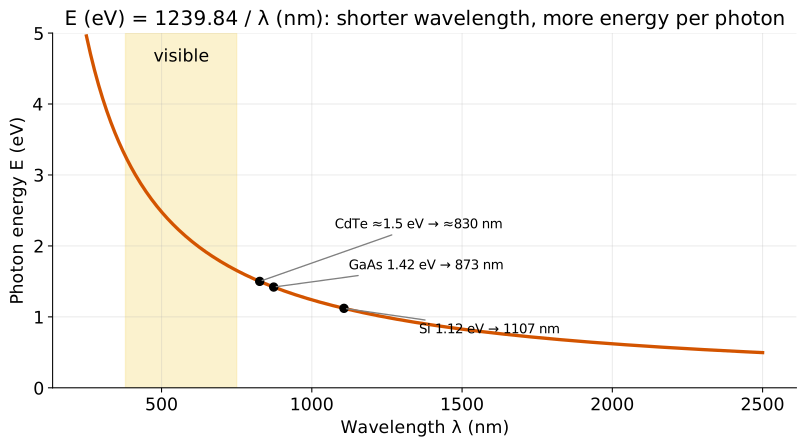
Because \(hc = 1.986 \times 10^{-25}\) J·m and 1 eV = \(1.602 \times 10^{-19}\) J, a handy shortcut is
Worked example 1 — photon energies
- Blue, 450 nm: \(E = 1239.84/450 = 2.76\) eV.
- Red, 700 nm: 1.77 eV.
- Silicon's band gap 1.12 eV corresponds to \(\lambda = 1239.84/1.12 = 1107\) nm.
The photoelectric effect
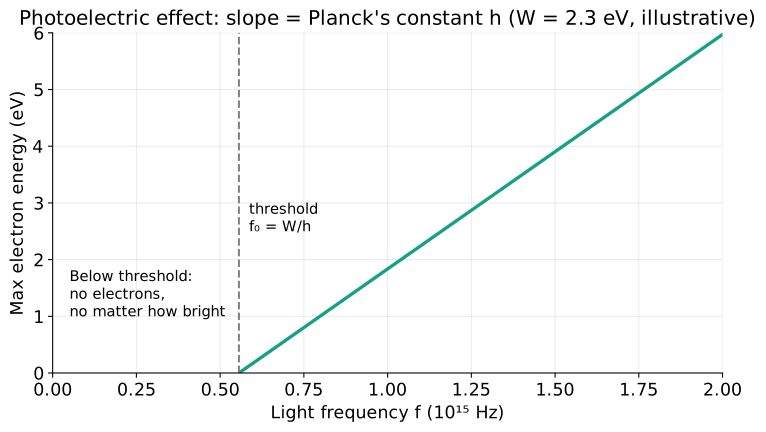
Shine light on a clean metal and electrons fly out — but only if the light's frequency is above a threshold, no matter how bright. Above the threshold, the electrons' maximum kinetic energy grows linearly with frequency, while brightness only changes how many electrons come out. Einstein explained it (Nobel Prize 1921): each photon gives its whole energy \(hf\) to one electron, which must spend a work function \(W\) to escape:
The photovoltaic effect (first observed by Edmond Becquerel in 1839) is the semiconductor cousin: a photon lifts an electron across the band gap inside the material instead of out of it, and a built-in field sorts the charges to make a voltage (Unit 11). The same one-photon-one-electron logic applies.
Photon flux versus power density
Photon flux \(\Phi\) is the number of photons per second per unit area. For monochromatic light of power density \(P\) (W/m²):
If every photon yielded one electron collected in the circuit, the current density would be \(J = q\Phi\), with \(q = 1.602 \times 10^{-19}\) C.
Worked example 2 — photons in a beam of 600 nm light
1000 W/m² at 600 nm. \(E = 1239.84/600 = 2.066\) eV \(= 3.31 \times 10^{-19}\) J. \(\Phi = 1000 / 3.31 \times 10^{-19} = 3.02 \times 10^{21}\) photons s⁻¹ m⁻². Maximum current density: \(J = q\Phi = 484\) A/m² \(= 48.4\) mA/cm².
Worked example 3 — same power, different colour
1000 W/m² at 400 nm gives only \(\Phi = 2.01 \times 10^{21}\) s⁻¹ m⁻² (each photon carries more energy, so fewer photons), so max \(J = 32.3\) mA/cm². Same watts, fewer photons, less current. This is why spectral response falls toward the blue even in a perfect cell.
The solar spectrum counted in photons
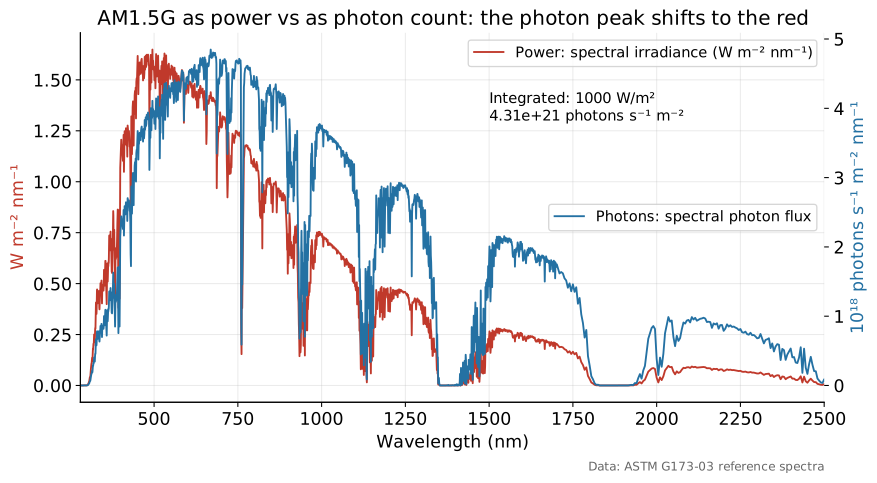
The sunlight spectrum can be plotted as power per wavelength (W m⁻² nm⁻¹) or as photons per wavelength. Converting each point with \(\Phi_\lambda = E_\lambda \lambda/(hc)\) shifts weight to the red, because red photons are "cheaper". For AM1.5G the power spectrum peaks near 495 nm, while the photon spectrum peaks near 670 nm (computed from ASTM G173).
Worked example 4 — silicon's maximum current
Integrating the AM1.5G photon flux for all wavelengths shorter than 1107 nm (photons with \(E \ge 1.12\) eV) gives \(\Phi \approx 2.73 \times 10^{21}\) s⁻¹ m⁻², so \(J_\text{max} = q\Phi \approx 43.8\) mA/cm² (computed in Unit 8). Today's best silicon cells reach roughly 41–42 mA/cm² (estimate); the gap is reflection, shading by metal and incomplete absorption near the band edge.
Spectral responsivity
A useful related quantity is spectral responsivity (A/W): current out per watt of light at a given wavelength. For a perfect cell (quantum efficiency 1),
At 1000 nm a perfect cell gives 0.81 A/W; at 400 nm only 0.32 A/W. Real cells multiply this by their quantum efficiency (SOL 202/401).
Wave or particle?
Both descriptions are correct in their domains: wave optics explains interference and coatings; the photon picture explains absorption and current. You will use both, sometimes in the same device.
Common misconceptions
Misconceptions
- "Brighter light has more energetic photons." No — brighter means more photons; each photon's energy is set by its wavelength.
- "A blue photon makes more current than a red one." Each absorbed photon gives at most one electron (in conventional cells). The blue photon's extra energy becomes heat.
- "A photon below the band gap gives a little current." It is (ideally) not absorbed at all; it passes through or is absorbed by free carriers and becomes heat.
What this means for manufacturing and the job
- Quantum efficiency (QE) tools measure electrons out per photon in at each wavelength — the standard way to diagnose front-surface, bulk and rear losses (SOL 401).
- Current matching in tandem cells is photon accounting between two absorbers (SOL 203/305).
- Spectral mismatch between a flash tester's lamp and AM1.5G must be corrected, because the cell counts photons, not watts (SOL 401).
Key equations
| Equation | In words |
|---|---|
| \(E = hc/\lambda\); \(E[\text{eV}] = 1239.84/\lambda[\text{nm}]\) | photon energy from wavelength |
| \(\Phi = P\lambda/(hc)\) | photons per second per area from power |
| \(J_\text{max} = q\Phi_{E\ge E_g}\) | maximum current: one electron per absorbed photon |
| \(SR = q\lambda/(hc)\) | ideal amps per watt |
Review questions
1. Energy of an 850 nm photon in eV and J?
1239.84/850 = 1.459 eV = 2.34 × 10⁻¹⁹ J.
2. What wavelength corresponds to GaAs's 1.42 eV band gap?
1239.84/1.42 = 873 nm.
3. 500 W/m² of 900 nm light falls on a perfect cell. Max current density?
\(\Phi = 500 \times 900\times10^{-9}/(6.626\times10^{-34}\times 3\times10^8) = 2.26\times10^{21}\) s⁻¹m⁻² → \(J = 363\) A/m² = 36.3 mA/cm². (Shortcut: \(SR = 900/1239.84 = 0.726\) A/W; × 500 W/m² = 363 A/m².)
4. Why does the photon spectrum of sunlight peak at a longer wavelength than the power spectrum?
Converting power to photons multiplies by λ; long-wavelength photons each carry less energy, so a given power contains more of them.
5. Doubling the brightness of 600 nm light doubles what, and leaves what unchanged?
Doubles photon flux and ideal current; photon energy (2.07 eV) is unchanged.
Sources
- PVEducation, "Energy of Photon", "Photon Flux", "Spectral Irradiance" pages.
- Einstein, Ann. Phys. 17, 132 (1905); Becquerel, C. R. Acad. Sci. 9, 561 (1839) — historical.
- CODATA 2018 constants (h, c, q exact in the 2019 SI).
- ASTM G173-03 reference spectra (photon integrals computed here).