Unit 3 — Waves and the Electromagnetic Spectrum
Big idea. Light is an electromagnetic wave: oscillating electric and magnetic fields travelling at \(c \approx 3 \times 10^8\) m/s. Its wavelength decides its colour and how materials interact with it. Solar cells care about a narrow window of wavelengths, roughly 300–1200 nm for silicon.
Learning objectives
- Describe a wave by wavelength, frequency, speed and amplitude; use \(c = \lambda f\).
- Place UV, visible and infrared on the electromagnetic spectrum.
- Explain refraction (refractive index) and interference qualitatively.
- Use the grating equation to predict where colours appear (Lab 101-A).
Why this matters
Anti-reflection coatings are interference devices; textured surfaces and glass rely on refraction; spectral response, quantum efficiency and the solar spectrum are all plotted against wavelength. You need fluency in "nanometres" before any of those make sense.
What a wave is
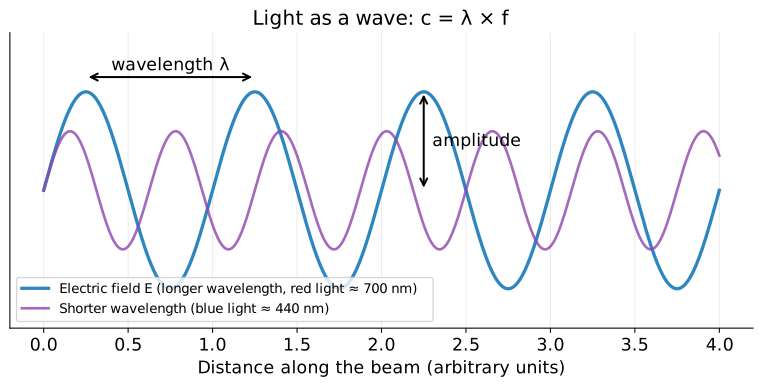
A wave is a travelling disturbance that carries energy without carrying matter along with it. For light, what oscillates is the electric field (and, at right angles, the magnetic field). Four quantities describe it:
- Wavelength \(\lambda\) — distance between crests (metres; for light usually nanometres, 1 nm = 10⁻⁹ m).
- Frequency \(f\) — crests passing per second (hertz).
- Speed — in vacuum, \(c = 299{,}792{,}458\) m/s for all wavelengths.
- Amplitude — the height of the oscillation; brightness (intensity) goes as amplitude squared.
In words: wavelength times frequency equals the speed of light — so short wavelength means high frequency.
Worked example 1 — frequency of green light
\(\lambda = 550\) nm \(= 5.50 \times 10^{-7}\) m. \(f = c/\lambda = 3.00 \times 10^8 / 5.50 \times 10^{-7} = 5.45 \times 10^{14}\) Hz — about half a million billion oscillations per second.
The electromagnetic spectrum
Radio waves, microwaves, infrared, visible light, ultraviolet, X-rays and gamma rays are all the same phenomenon at different wavelengths. Human eyes see only about 380–750 nm. Sunlight reaching the ground spans roughly 280–4000 nm (the range tabulated in the ASTM G173 standard), with most of its power between about 300 and 2500 nm.
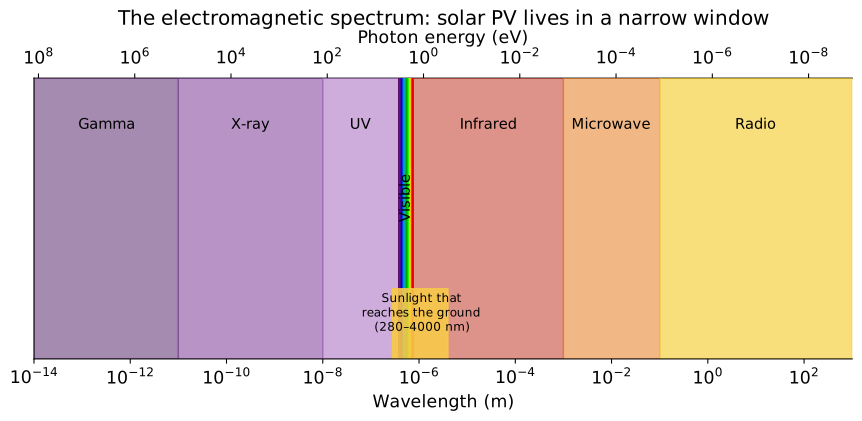
| Region | Wavelength | Relevance to PV |
|---|---|---|
| UV-B / UV-A | 280–400 nm | ≈ 5 % of AM1.5G power; degrades polymers (encapsulant yellowing, UVID in SOL 403) |
| Visible | 380–750 nm | ≈ 50 % of AM1.5G power; strongly absorbed by Si |
| Near-IR | 750–1200 nm | Si still absorbs up to ≈ 1107 nm but weakly near the edge → light trapping needed |
| IR beyond 1200 nm | > 1200 nm | ≈ 19 % of AM1.5G beyond 1107 nm passes through Si unused; heats modules |
(Percentages computed from the ASTM G173 AM1.5G table in Unit 8.)
Light in materials: refraction
In a material light slows to \(v = c/n\), where \(n\) is the refractive index. Frequency stays the same, so the wavelength inside shrinks to \(\lambda/n\). At a boundary, light bends (Snell's law, \(n_1 \sin\theta_1 = n_2 \sin\theta_2\)) and part of it reflects (Unit 9).
| Material | \(n\) (visible, approx.) |
|---|---|
| air | 1.000 |
| water | 1.33 |
| solar glass, EVA | ≈ 1.5 |
| silicon nitride (ARC) | ≈ 2.0 |
| crystalline silicon (600 nm) | ≈ 3.9 |
The larger the jump in \(n\), the more light reflects — bare silicon reflects over 30 % of visible light, which is why every cell has texture and an anti-reflection coating.
Worked example 2 — wavelength inside glass
550 nm light enters glass with \(n = 1.5\): speed \(= 3.0 \times 10^8/1.5 = 2.0 \times 10^8\) m/s; wavelength inside \(= 550/1.5 \approx 367\) nm.
Interference
When two waves overlap, their fields add. Crests on crests make a brighter result (constructive interference); crests on troughs cancel (destructive). A thin transparent film — like the ≈ 75 nm silicon-nitride layer on a solar cell — reflects light from its top and bottom surfaces; if the film is a quarter-wavelength thick inside the material, the two reflections cancel. That is why cells look dark blue: red and green reflections are suppressed, some blue/violet still reflects. (Worked fully in SOL 102 Unit 9 and SOL 203.)
Diffraction gratings — your first instrument
A diffraction grating has many parallel lines spaced \(d\) apart. Light of wavelength \(\lambda\) leaves at angles \(\theta\) where waves from neighbouring lines arrive in step:
In words: each colour is sent off at its own angle, so white light spreads into a rainbow. This is the principle of the spectrometer you build in Lab 101-A.
Worked example 3 — where does green appear?
A 500 lines/mm grating has \(d = 1/500\) mm \(= 2.0\ \mu\)m. For \(\lambda = 550\) nm, first order: \(\sin\theta = 0.55/2.0 = 0.275\) → \(\theta = 16.0°\). Red (700 nm): \(\sin\theta = 0.35\) → 20.5°. Violet (400 nm): 11.5°.
Common misconceptions
Misconceptions
- "Infrared is heat, visible is light." Both are light; infrared is just longer-wavelength light that our eyes don't detect. Any absorbed light becomes heat.
- "Colour is a property of light only." Perceived colour also depends on eye sensitivity; a cell's blue look is from interference in its coating, not a blue material.
- "Light slows down in glass so it loses energy." It slows and its wavelength shrinks, but its frequency (and photon energy, Unit 4) is unchanged.
What this means for manufacturing and the job
- Anti-reflection coatings (SiNₓ by PECVD; AR coatings on glass) are interference films whose thickness is controlled to a few nm (SOL 302, 304).
- Spectral measurements — reflectance, quantum efficiency, spectrometers in sun simulators — all use wavelength language (SOL 401).
- UV exposure drives encapsulant and cell degradation tests (SOL 403).
Review questions
1. What is the frequency of 1000 nm infrared light?
\(f = 3.0 \times 10^8 / 1.0 \times 10^{-6} = 3.0 \times 10^{14}\) Hz.
2. If \(n_\text{Si} = 3.9\), what is the wavelength of 800 nm light inside silicon?
800/3.9 ≈ 205 nm.
3. A grating gives first-order red (650 nm) at 19°. What is its line spacing?
\(d = \lambda/\sin\theta = 650/\sin 19° = 650/0.3256 \approx 1996\) nm ≈ 2.0 µm → about 500 lines/mm.
4. Why do solar cells look dark blue?
The silicon-nitride anti-reflection film is designed to cancel reflection near 600 nm; shorter (blue/violet) wavelengths are less well cancelled and some reflect.
5. Roughly what fraction of AM1.5G power lies in the visible band?
About half (≈ 50 % between 380 and 750 nm, computed from ASTM G173).
Sources
- PVEducation, "Properties of Light" pages.
- Hecht, Optics (any edition) — waves, interference, gratings.
- ASTM G173-03 reference spectra (band fractions computed here).
- Refractive index of Si: Green, Sol. Energy Mater. Sol. Cells 92, 1305 (2008).