Unit 7 — The Atmosphere: Absorption, Scattering, Air Mass, AM1.5G/AM1.5D
Big idea. On its way down, sunlight is absorbed by specific molecules (ozone, oxygen, water vapour, CO₂) and scattered by air molecules and aerosols. How much depends on the path length through the air — the air mass. The industry standard ground spectrum, AM1.5G, describes sunlight on a tilted surface after passing through 1.5 atmospheres' worth of air and integrates to 1000 W/m².
Learning objectives
- Name the main absorbers and which wavelengths they remove.
- Explain Rayleigh and aerosol (Mie) scattering and why the sky is blue.
- Compute air mass from solar zenith angle.
- Distinguish direct, diffuse and global irradiance; AM1.5G vs AM1.5D.
- State the conditions that define the ASTM G173 AM1.5 spectra.
Why this matters
Every efficiency on a terrestrial datasheet is measured under the AM1.5G spectrum (IEC 60904-3, equivalent to ASTM G173). Factory flash testers are graded on how well they match it (SOL 401). The water-vapour gaps in the spectrum are also why silicon "wastes" little near-IR and why the photon budget for tandems looks the way it does.
Absorption by molecules
Molecules absorb photons whose energy matches their internal transitions:
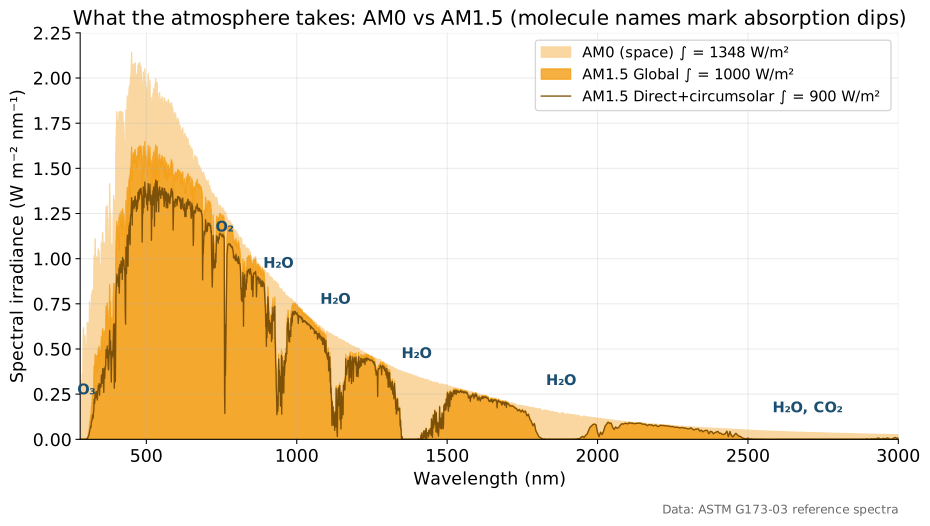
- Ozone (O₃) absorbs strongly below about 300–320 nm (protecting life from UV-C/UV-B) and weakly across the visible (Chappuis band).
- Oxygen (O₂) has a sharp band at 760 nm (the "A-band").
- Water vapour (H₂O) removes bands near 720, 820, 940, 1130, 1400 and 1900 nm and much beyond 2500 nm. The amount varies hugely with weather — the main reason real spectra deviate from the standard.
- Carbon dioxide (CO₂) absorbs near 2000 and 2700 nm and further in the IR.
Scattering
Rayleigh scattering by air molecules much smaller than the wavelength scales as \(1/\lambda^4\):
so 450 nm blue light is scattered \((700/450)^4 \approx 5.9\) times more than 700 nm red. Scattered blue light fills the sky (blue sky); the direct beam loses blue, so the Sun looks yellow-white at midday and red at sunset when the path is long. Aerosol (Mie) scattering by particles comparable to the wavelength (dust, smoke, haze) is less wavelength-selective and makes the sky whitish.
Scattering does not destroy light — it redirects it. Some reaches the ground as diffuse light from the whole sky.
Air mass
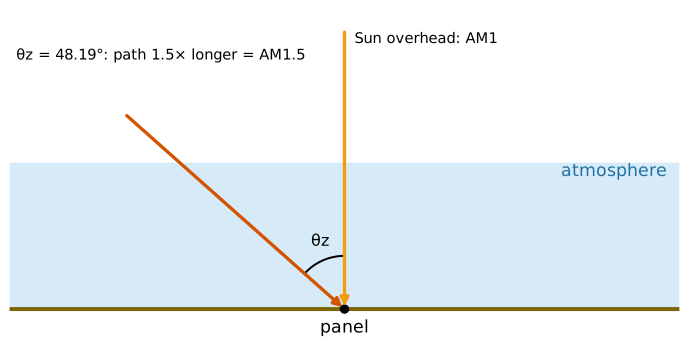
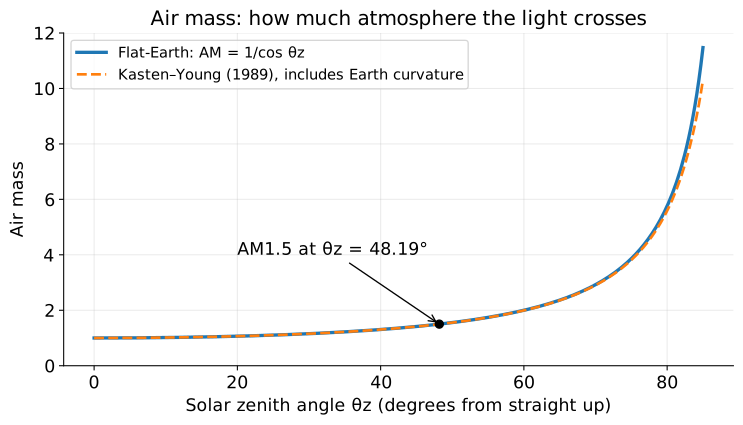
Air mass (AM) is the path length of sunlight through the atmosphere relative to the straight-down path. For a flat atmosphere,
where \(\theta_z\) is the solar zenith angle (angle from straight up). Sun overhead: AM1. At \(\theta_z = 60°\): AM2. AM1.5 corresponds to \(\theta_z = 48.19°\). Above the atmosphere: AM0.
Worked example 1 — air mass in Chicago
Chicago is at latitude 41.9° N. At solar noon on the equinox, \(\theta_z \approx 41.9°\) → \(AM = 1/\cos 41.9° = 1.34\). At noon on the December solstice, \(\theta_z \approx 41.9 + 23.4 = 65.3°\) → \(AM \approx 2.4\). On the June solstice, \(\theta_z \approx 18.5°\) → \(AM \approx 1.05\).
A rough empirical estimate of direct-beam intensity (Meinel & Meinel, as given on PVEducation) is \(I_D \approx 1.353 \times 0.7^{(AM^{0.678})}\) kW/m². At AM1.5: \(0.7^{1.316} = 0.625\), so \(I_D \approx 0.85\) kW/m² — consistent with AM1.5D's 900 W/m² (which includes a little circumsolar light).
Direct, diffuse and global
- Direct normal irradiance (DNI) — the beam from the solar disc, measured facing the Sun.
- Diffuse irradiance — scattered light from the rest of the sky (and reflected from the ground).
- Global irradiance — total on a surface: direct component projected onto the surface plus diffuse. On a horizontal surface: \(GHI = DNI \cos\theta_z + DHI\).
On a clear day diffuse light is perhaps 10–20 % of global; under overcast skies it is nearly 100 % (estimates). Flat-plate PV modules use both; concentrators use only the direct beam.
The ASTM G173 / IEC 60904-3 reference spectra
To compare cells fairly, the industry fixed one spectrum. ASTM G173-03 (generated with the SMARTS radiative-transfer model) defines:
| Condition | Value |
|---|---|
| Surface | tilted 37° toward the Sun (≈ average latitude of the contiguous US) |
| Air mass | 1.5 (zenith angle 48.19°) |
| Atmosphere | 1976 US Standard Atmosphere, rural aerosol model |
| Precipitable water | 1.42 cm |
| Ozone | 0.34 atm·cm |
| Aerosol optical depth | 0.084 at 500 nm |
| AM1.5G | global on the tilted plane, integrates to ≈ 1000 W/m² |
| AM1.5D | direct + circumsolar (2.5° half-angle), ≈ 900 W/m² |
IEC 60904-3 uses the same global spectrum for terrestrial PV testing. Why 1.5? It represents typical mid-latitude conditions over a year better than AM1 (Sun overhead, rare outside the tropics); the choice dates from 1970s–80s US/European standardisation.
Worked example 2 — what the atmosphere removes
From the G173 integrals: AM0 → AM1.5G loses 1348 − 1000 = 348 W/m² (26 %) on the 37° tilted plane. In the UV below 400 nm the drop is larger in proportion: 7.6 % of AM0 is UV, but only 4.6 % of AM1.5G. Beyond 1107 nm (silicon's cutoff), AM0 has 24.8 % of its power while AM1.5G has 19.2 % — the water bands remove much near-IR.
Real spectra vary
Real outdoor spectra shift with air mass (redder in morning/evening), humidity (deeper water bands), haze and clouds (bluer diffuse light). These shifts change cells differently depending on band gap: wide-gap cells (a-Si, perovskite) respond better to bluer light; silicon is relatively tolerant. This "spectral effect" is part of energy-yield modelling (SOL 304).
Common misconceptions
Misconceptions
- "AM1.5 means 1.5 kW/m²." No — AM is a path length; AM1.5G is normalised to 1000 W/m².
- "Scattered light is lost." Much reaches the ground as diffuse light, which flat panels use.
- "Clouds block all light." Overcast days still give 10–30 % of clear-sky irradiance (rough estimate) — mostly diffuse.
- "The standard spectrum is what my panel sees." It is a reference; real spectra vary hour by hour.
What this means for manufacturing and the job
- Sun simulators in cell and module lines are classified by spectral match to AM1.5G in wavelength bins (IEC 60904-9). Engineers check spectral class, uniformity and temporal stability (SOL 401).
- Reference cells calibrated to AM1.5G set the irradiance level of flash testers every shift.
- Spectral mismatch factors correct measurements when test and reference cells differ in spectral response.
Key equations
| Equation | In words |
|---|---|
| \(AM = 1/\cos\theta_z\) | path length through air relative to overhead |
| scattering \(\propto \lambda^{-4}\) | blue scatters much more than red |
| \(GHI = DNI\cos\theta_z + DHI\) | horizontal global = projected beam + diffuse |
Review questions
1. What zenith angle gives AM2?
cos θz = 0.5 → θz = 60°.
2. Why is the sky blue and the setting Sun red?
Rayleigh scattering ∝ 1/λ⁴ sends blue light across the sky; at sunset the long path removes blue from the direct beam, leaving red.
3. Name the molecule responsible for the 940 nm and 1400 nm dips.
Water vapour.
4. List four conditions that define AM1.5G in ASTM G173.
37° tilt; AM1.5 (48.19° zenith); 1.42 cm precipitable water; 0.34 atm·cm ozone; AOD 0.084 at 500 nm; US Standard Atmosphere 1976 with rural aerosol. Integrated ≈ 1000 W/m².
5. Why does AM1.5D integrate to less than AM1.5G?
AM1.5D includes only the direct (plus small circumsolar) beam; AM1.5G adds sky-diffuse and ground-reflected light on the tilted plane.
Sources
- ASTM G173-03, Standard Tables for Reference Solar Spectral Irradiances: Direct Normal and Hemispherical on 37° Tilted Surface; data via the NREL RReDC page (copy used here: pvlib-python repository
pvlib/data/ASTMG173.csv). - Gueymard, SMARTS model documentation (basis of G173).
- Kasten & Young, Applied Optics 28, 4735 (1989) — air-mass formula.
- PVEducation, "Air Mass" and "Standard Solar Spectra" pages (Meinel formula).
- IEC 60904-3 (terrestrial reference spectrum) and IEC 60904-9 (simulator classes) — named, not opened.