Unit 6 — The Sun from Space: the Solar Constant and AM0
Big idea. Above the atmosphere, sunlight arrives at about 1361 W/m² on a surface facing the Sun. You can derive this number from the Sun's temperature and size and the Earth–Sun distance. The corresponding spectrum is called AM0 ("air mass zero") and is the standard for space solar cells — directly relevant to SpaceX/Starlink solar work.
Learning objectives
- Derive the solar constant from \(\sigma T^4\) and the inverse-square law.
- Explain why the extraterrestrial irradiance varies ±3.3 % through the year.
- Describe the AM0 spectrum and how it differs from blackbody and ground spectra.
- Explain why space solar cells are rated under AM0 instead of AM1.5.
Why this matters
AM0 is the starting point from which the atmosphere carves the terrestrial spectrum (Unit 7). It is also the operational spectrum for satellites: space arrays are tested and rated under AM0, and the space environment (radiation, thermal cycling, atomic oxygen) adds requirements covered in SOL 403/404. SpaceX postings for space solar roles explicitly mention qualification for the space environment (see 01-job-requirements.md).
Deriving the solar constant
The Sun radiates power \(L = 4\pi R_\odot^2 \, \sigma T_\text{eff}^4\) (surface area × Stefan–Boltzmann). At distance \(d\) that power is spread over a sphere of area \(4\pi d^2\), so the irradiance is
In words: surface brightness times the square of (Sun radius ÷ distance). This is the inverse-square law: double the distance, quarter the irradiance.
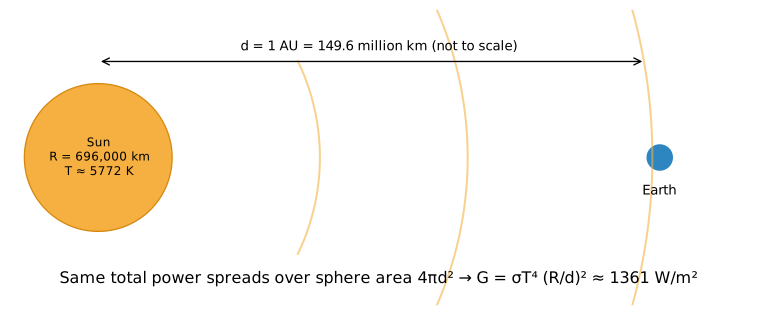
Worked example 1 — compute the solar constant
\(T_\text{eff} = 5772\) K, \(R_\odot = 6.957 \times 10^8\) m, \(d = 1.496 \times 10^{11}\) m (1 AU). \(\sigma T^4 = 6.294 \times 10^7\) W/m². \((R_\odot/d)^2 = (4.650\times10^{-3})^2 = 2.163 \times 10^{-5}\). \(G_0 = 6.294\times10^7 \times 2.163\times10^{-5} \approx\) 1361 W/m² — matching the measured total solar irradiance.
The measured value
The solar constant is measured by satellite radiometers as the total solar irradiance (TSI). Kopp & Lean (2011) established 1360.8 ± 0.5 W/m² at solar minimum, often rounded to 1361 W/m². It varies by only about 0.1 % over the 11-year sunspot cycle. Older literature (and the ASTM E490 AM0 standard) uses about 1366 W/m²; you will meet both numbers.
Seasonal variation: the elliptical orbit
Earth's orbit is slightly elliptical (eccentricity ≈ 0.0167). Since irradiance ∝ 1/d², the extraterrestrial irradiance is about 3.3 % above average at perihelion (early January) and 3.3 % below at aphelion (early July).
![Extraterrestrial irradiance through the year, approximated as \(G = 1361\,[1 + 0.033\cos(2\pi(n-3)/365)]\), where \(n\) is day of year. Northern-hemisphere winter is closer to the Sun — seasons are caused by axial tilt, not distance.](/figures/101-u6-seasonal.svg)
Earth's average: why 340 W/m²
Earth intercepts sunlight on a disc of area \(\pi R_E^2\) but has surface area \(4\pi R_E^2\), so the time- and globe-averaged top-of-atmosphere irradiance is \(1361/4 \approx 340\) W/m². Climate scientists quote this number; solar engineers care about the full 1361 W/m² on a Sun-facing surface.
The AM0 spectrum
AM0 is the solar spectrum just outside the atmosphere. The ASTM standards tabulate it: ASTM E490 (space; integrates to about 1366 W/m²) and the extraterrestrial column of ASTM G173 (280–4000 nm; integrates to 1348 W/m² over that range in our calculation — less than the TSI because wavelengths below 280 nm and above 4000 nm are not included).
Look back at the Unit 5 figure comparing AM0 with a 5772 K blackbody: AM0 has its peak near 450 nm in the G173 table, with a jagged UV–blue region full of absorption lines. Compared with the ground spectrum (Unit 7), AM0 has much more UV and blue and no water-vapour gaps.
Why the Sun is nearly parallel light
The Sun's disc spans about 0.53° as seen from Earth (half-angle ≈ 0.267°). That near-parallel beam is why lenses and mirrors can concentrate sunlight — up to a theoretical maximum of \(1/\sin^2(0.267°) \approx 46{,}000\) suns — and why the "direct" and "diffuse" parts of sunlight behave so differently once the atmosphere scatters some of it (Unit 7).
Space solar cells and AM0 rating
Satellites see AM0 continuously when in sunlight. Space cells are therefore calibrated against AM0 (e.g., ISO 15387 covers measurement and calibration of space solar cells), usually with high-altitude balloon or aircraft-calibrated reference cells. Because AM0 is about 36 % brighter than the 1000 W/m² terrestrial standard and bluer, the same cell gives a different efficiency number under the two conditions — always check which spectrum an efficiency refers to. Space arrays historically used multi-junction III–V cells (GaInP/GaAs/Ge); low-cost constellations increasingly consider silicon (a trend discussed in SOL 305/404; verify current practice).
Worked example 2 — same cell, two ratings
A 4 cm² cell delivers 0.124 W under AM0 (0.1361 W/cm²) → \(\eta_{AM0} = 0.124/(4 \times 0.1361) = 22.8\) %. Under AM1.5G (0.100 W/cm²) the same cell might deliver 0.098 W → \(\eta_{AM1.5} = 24.5\) %. (Illustrative numbers.) Efficiencies differ because the spectra differ; there is no contradiction.
Common misconceptions
Misconceptions
- "Summer is hot because Earth is closer to the Sun." In the northern hemisphere, Earth is farthest from the Sun in July; seasons are from axial tilt.
- "The solar constant is exactly constant." It varies ~0.1 % with solar activity and ±3.3 % with distance.
- "1361 vs 1366 vs 1348 — one must be wrong." They refer to different measurements/standards and wavelength ranges.
- "Cells in space are always more efficient." Their power is higher (more light), but rated efficiency can be lower under AM0's bluer spectrum, and they degrade from radiation.
What this means for manufacturing and the job
- SpaceX/Starlink solar manufacturing must test under AM0-type simulators and qualify cells for radiation and thermal cycling (SOL 401/403).
- Calibration chains — reference cells traced to primary standards — exist for both AM0 and AM1.5 (SOL 401).
- Spectral content matters: space arrays get more UV, which drives coverglass and adhesive choices.
Key equations
| Equation | In words |
|---|---|
| \(G_0 = \sigma T^4 (R_\odot/d)^2\) | solar constant from Sun's temperature and geometry |
| \(G \propto 1/d^2\) | inverse-square law |
| \(G(n) \approx 1361[1 + 0.033\cos(2\pi(n-3)/365)]\) | annual variation |
Review questions
1. Mars orbits at about 1.52 AU. What is the solar irradiance there?
1361/1.52² ≈ 589 W/m².
2. Why does the G173 AM0 table integrate to 1348 W/m² rather than 1361?
It covers only 280–4000 nm; the missing UV and far-IR tails, plus differences in the underlying data, account for the gap.
3. What is the irradiance on 3 January vs 4 July (approx.)?
≈ 1406 W/m² vs ≈ 1316 W/m².
4. Why is the globally averaged TOA irradiance one quarter of the solar constant?
Earth intercepts on a disc πR² but the energy is averaged over the sphere 4πR².
5. Why must a space-cell efficiency always state AM0?
Efficiency depends on the spectrum and the input power; AM0 is brighter (≈ 1361 W/m²) and bluer than AM1.5G.
Sources
- Kopp & Lean, "A new, lower value of total solar irradiance", Geophys. Res. Lett. 38, L01706 (2011).
- IAU 2015 Resolution B3 (nominal solar radius and effective temperature); IAU 2012 definition of the astronomical unit.
- ASTM E490 (AM0) and ASTM G173-03 (extraterrestrial column; integrated here).
- PVEducation, "Solar Radiation in Space" page (seasonal variation formula).
- ISO 15387 (space single-junction cells: measurement and calibration) — named, not opened.