Unit 10 — Glass, Polymers and Metals for Modules
Big idea. A solar module is a materials sandwich designed to keep fragile cells working for 25–30+ years outdoors: a front sheet of tempered low-iron glass, polymer encapsulant that bonds and cushions, a polymer backsheet or second glass, copper interconnects with solder, an aluminium frame, silicone seals and a junction box. Each material is chosen for optical, mechanical, electrical and chemical properties — and their mismatched thermal expansion is a lifelong source of stress.
Learning objectives
- Describe the layers of a glass–backsheet and a glass–glass module and the job of each.
- Explain why solar glass is low-iron, tempered and AR-coated.
- Compare EVA and POE encapsulants; explain cross-linking and acetic-acid corrosion.
- Explain the roles of silver, aluminium, copper and solder; compare conductivities.
- Compute thermal-expansion mismatch strain and connect it to thermal-cycling failures.
Why this matters
Module materials are roughly as important as cells for cost and reliability: ITRPV estimates that non-cell materials and processing are a large share of module cost (about 40–45 % per the ITRPV 17 module chapter as summarised in this curriculum). Encapsulant and interconnect degradation are the top concerns in IEA PVPS Task 13 reliability reports (SOL 403).
The module stack
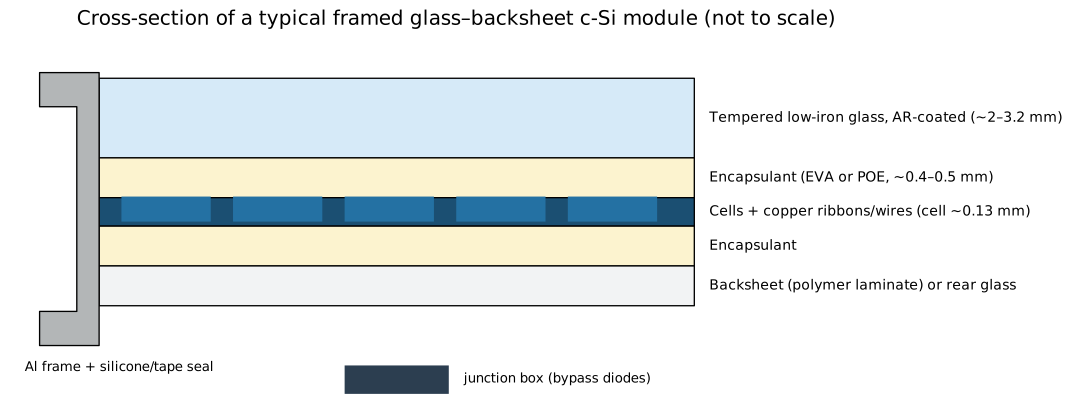
| Layer | Typical material | Job |
|---|---|---|
| Front sheet | tempered low-iron soda-lime glass, ~2–3.2 mm, AR-coated | transmit light, carry mechanical load, keep water out |
| Encapsulant | EVA or POE (or EPE co-extruded), ~0.4–0.5 mm per side | bond layers, optical coupling, cushion cells, electrical insulation |
| Cells + interconnects | Si cells, Cu ribbons/wires coated with solder | generate and carry current |
| Back sheet | polymer laminate (PET core with fluoropolymer or coated outer layers) or second glass (glass–glass, common for bifacial) | protect rear, insulate electrically |
| Frame | extruded aluminium | stiffness, mounting |
| Junction box | polymer box, bypass diodes, cables/connectors | output terminals; protect shaded strings |
(Thicknesses: typical published values, approximate.)
Glass
Soda-lime glass is an amorphous network of SiO₂ (~70+ %) modified by Na₂O and CaO, which lower its melting temperature. Ordinary window glass contains iron oxide that absorbs near-IR (the green tint at the edge). Low-iron "solar" glass removes most of it, raising solar transmission to around 91 % uncoated for 3.2 mm (estimate). A porous silica AR coating (refractive index ~1.2–1.3) cuts front reflection, adding roughly 2–3 % transmission (estimate). Glass is thermally tempered: heated and rapidly air-quenched, so the surface is in compression; this makes it several times stronger and safer (it breaks into small pieces). Glass–glass modules often use 2 mm heat-strengthened sheets on both sides. Glass is an excellent moisture barrier — nearly impermeable.
Polymers: encapsulants and backsheets
Polymers are long chain molecules; their properties come from chain chemistry, entanglement, crystallinity and cross-linking.
- EVA (ethylene-vinyl acetate) — the classic encapsulant (vinyl acetate content around 28–33 %; estimate). During lamination (~140–150 °C under vacuum; estimate) peroxides cross-link it into a rubbery, non-melting network. Downsides: it can generate acetic acid when it degrades with heat, moisture and UV, which corrodes metallisation; relatively high water-vapour transmission; can contribute to potential-induced degradation (PID).
- POE (polyolefin elastomer) — no acetate groups (no acetic acid), lower water-vapour transmission, high volume resistivity (better PID resistance). Widely used for n-type TOPCon/HJT and glass–glass modules; harder to process (adhesion, slip). EPE (EVA/POE/EVA co-extruded) combines them.
- Backsheets — multilayer: a PET core for electrical insulation and mechanical strength, protected by weatherable outer layers (fluoropolymers such as PVF/PVDF, or coatings). Backsheet cracking has been a notable field failure (IEA PVPS Task 13).
Adhesion between polymer and glass uses silane coupling agents that bond covalently to the glass surface and entangle with the polymer.
Metals
| Metal | Resistivity (µΩ·cm, ~20 °C) | Role |
|---|---|---|
| Silver | 1.59 | screen-printed front (and rear) fingers and busbar pads; low-temperature pastes for HJT |
| Copper | 1.68 | ribbons/wires (interconnects), plated contacts (emerging) |
| Aluminium | 2.65 | rear paste in PERC/Al-BSF; frame |
| Tin-based solder | ~10–15 (alloy-dependent; estimate) | joins Cu interconnects to cell pads |
Silver pastes contain Ag particles, glass frit and organic binder. During firing the frit etches through the SiNₓ ("fire-through") so silver contacts the emitter. Silver is a cost and supply concern; roadmaps track mg per cell and per watt and push for thinner fingers, multi-wire/0BB interconnection and copper substitution (ITRPV 17).
Thermal expansion mismatch
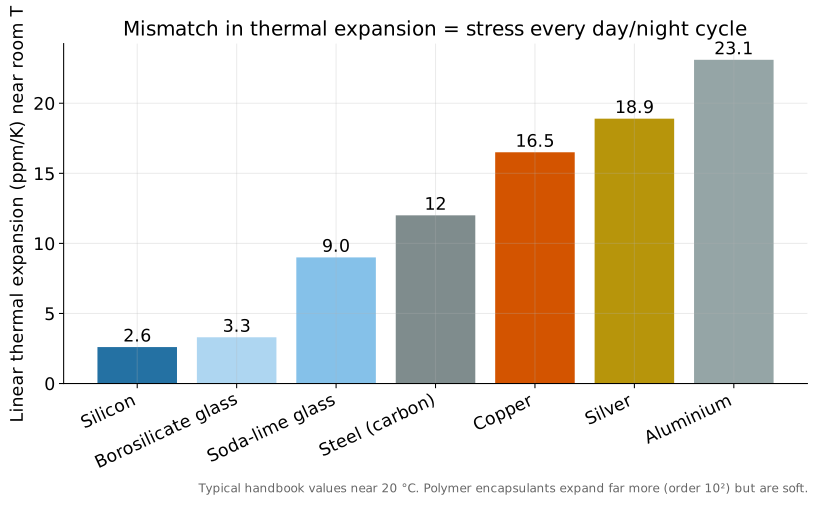
Each material expands by a fraction \(\alpha \Delta T\) when heated. Bonded materials with different \(\alpha\) fight each other:
Worked example — copper on silicon over a thermal cycle
IEC 61215's thermal-cycling test swings modules between −40 °C and +85 °C (\(\Delta T = 125\) K). Mismatch strain between Cu ribbon and Si: \((16.5 - 2.6)\times10^{-6}\times125 = 1.7\times10^{-3}\) (0.17 %). Copper's elastic limit is reached at a strain of very roughly 10⁻³ or less for soft annealed ribbon (estimate: yield ~50–100 MPa / modulus ~120 GPa), so part of every cycle is plastic deformation in the copper or solder. Repeated hundreds or thousands of times, this fatigues solder joints and ribbons — a classic field failure mode (SOL 403). Thinner/softer interconnects and stress-relief designs reduce it.
Moisture, UV and the 25-year problem
Polymers let water vapour through (glass and metal don't). Moisture plus heat drives corrosion of contacts, hydrolysis of PET backsheets and EVA acetic-acid formation. UV breaks polymer bonds (yellowing, embrittlement), so encapsulants contain UV absorbers and stabilisers — and UV transmission affects UV-induced degradation of cells (UVID; SOL 403). Accelerated tests in IEC 61215 include damp heat (85 °C / 85 % RH for 1000 h), thermal cycling (−40/+85 °C, 200 cycles) and humidity-freeze, plus UV preconditioning.
Common misconceptions
Misconceptions
- "The glass is just a window." It is the main structural element and moisture barrier.
- "Encapsulant is glue." It is also an optical coupler, electrical insulator and mechanical cushion — and its chemistry affects corrosion and PID.
- "Silver is used because it's traditional." It has the best conductivity and works with fire-through paste chemistry; replacing it is an active engineering race.
- "A 25-year warranty means nothing degrades." Warranties typically allow gradual power loss (SOL 403); materials engineering limits it.
What this means for manufacturing and the job
- Lamination (vacuum, temperature, time, cross-linking degree measured by gel content) is a key module-line process (SOL 304).
- Stringing/soldering quality and interconnect choices are frequent topics in module-engineering roles (SOL 304/402).
- Bill of materials decisions (glass thickness, POE vs EVA, backsheet vs glass–glass) are reliability-cost trade-offs (SOL 403/404).
Review questions
1. Why is solar glass low-iron?
Iron oxide absorbs near-IR and some visible light; removing it raises transmission to the cells.
2. Give two advantages of POE over EVA.
No acetic-acid formation; lower water-vapour transmission; higher volume resistivity (better PID resistance).
3. Mismatch strain between Al frame (23.1 ppm/K) and glass (9.0 ppm/K) over 125 K?
(23.1 − 9.0) × 10⁻⁶ × 125 = 1.8 × 10⁻³.
4. What does 'fire-through' mean for silver paste?
During firing, glass frit in the paste dissolves the SiNₓ coating locally so silver can contact the silicon emitter.
5. Name the IEC 61215 damp-heat test conditions.
85 °C, 85 % relative humidity, 1000 hours.
Sources
- PVEducation, "Module Structure" and "Module Materials" pages.
- IEA PVPS Task 13, T13-30:2025 (degradation of encapsulants and interconnects) — executive summary consulted.
- ITRPV 17th ed. (2026), module and metallisation chapters (silver, encapsulant/glass trends; partially read).
- CRC Handbook / ASM — resistivities, CTEs.
- IEC 61215 test conditions (well-documented values; standard itself not opened).