Unit 10 — Variability of Irradiance and Temperature; STC vs NOCT/NMOT
Big idea. Outdoors, light level, spectrum and cell temperature change constantly. To compare products, the industry fixed Standard Test Conditions (STC): 1000 W/m², AM1.5G, cell at 25 °C. Real cells run hotter, and hotter silicon makes less voltage — roughly 0.3–0.4 % less power per °C. NOCT/NMOT describe more realistic operating temperatures.
Learning objectives
- State STC and explain why each of its three conditions was chosen.
- Explain how current and voltage respond to irradiance (linear vs logarithmic).
- Estimate cell temperature with the NOCT model and the resulting power loss from temperature coefficients.
- Distinguish NOCT and NMOT and explain why datasheets give both STC and NMOT ratings.
Why this matters
Every module leaving a factory is flash-tested at STC and labelled with its STC power; warranty, binning and price follow from it. Temperature coefficients are a key selling point of TOPCon and HJT over PERC. Understanding what STC does not capture is essential for reliability and energy-yield work (SOL 304/403).
Standard Test Conditions
| STC parameter | Value | Why |
|---|---|---|
| Irradiance | 1000 W/m² | round number close to clear-sky noon irradiance on a well-tilted surface |
| Spectrum | AM1.5G (IEC 60904-3 / ASTM G173) | representative mid-latitude spectrum (Unit 7) |
| Cell temperature | 25 °C | easy to hold in a lab; a fixed reference for comparisons |
Factory flash testers fire a pulse of light lasting milliseconds so the cell does not heat up during the measurement — the only practical way to measure at 25 °C cell temperature under 1000 W/m².
How a cell responds to light level
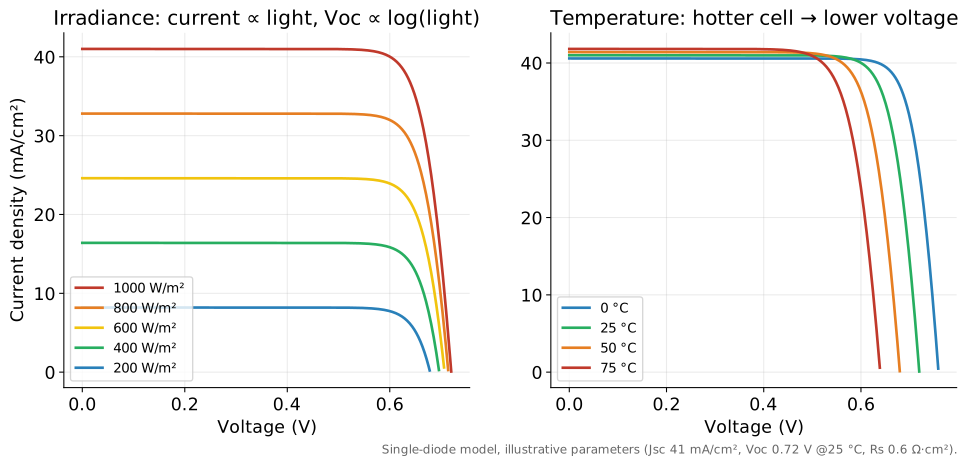
Two rules of thumb (derived in SOL 202 from the diode equation):
- Current is proportional to irradiance: \(I_{sc} \propto G\). Twice the photons, twice the current.
- Voltage grows only logarithmically: \(V_{oc} \approx \frac{n k_B T}{q} \ln\!\left(\frac{I_{sc}}{I_0}\right)\), so each halving of light costs about \((k_BT/q)\ln 2 \approx 18\) mV per cell at 25 °C (ideality \(n = 1\)).
Worked example 1 — low light
At 200 W/m² instead of 1000: \(I_{sc}\) falls to 20 %. \(V_{oc}\) falls by \((0.0257\ \text{V}) \ln 5 = 41\) mV per cell (≈ 6 % of 0.72 V). Power falls to a little under 20 % of STC (the fill factor can even improve slightly when series resistance losses shrink).
How a cell responds to temperature
Raising temperature increases the intrinsic carrier concentration and the dark (saturation) current \(I_0\) exponentially, so \(V_{oc}\) falls: about −2.2 mV/°C per silicon cell (PVEducation). The band gap shrinks slightly, so \(I_{sc}\) rises a little (≈ +0.04–0.05 %/°C; estimate). Net effect: power falls.
Datasheets give three temperature coefficients: \(\alpha\) for \(I_{sc}\) (%/°C, small positive), \(\beta\) for \(V_{oc}\) (%/°C, negative) and \(\gamma\) for \(P_\text{max}\) (%/°C, negative). Typical \(\gamma\) values (datasheet ranges; estimate):
| Technology | γ (P_max) |
|---|---|
| PERC (p-type) | about −0.34 to −0.37 %/°C |
| TOPCon (n-type) | about −0.29 to −0.32 %/°C |
| HJT (n-type) | about −0.24 to −0.26 %/°C |
Higher-voltage cells (HJT) are less temperature-sensitive because their \(V_{oc}\) is closer to its ideal value.
How hot do cells get? NOCT and NMOT
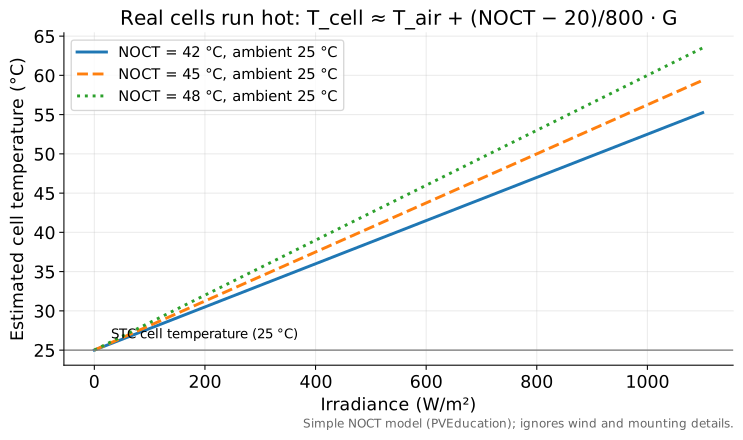
NOCT (Nominal Operating Cell Temperature) is the cell temperature of an open-circuited module under 800 W/m², 20 °C air, 1 m/s wind, open-rack mounting. Datasheets typically list NOCT in the low-to-mid 40s °C (estimate; check each datasheet). A simple model (PVEducation):
In words: the cell runs above the air by an amount proportional to irradiance.
NMOT (Nominal Module Operating Temperature, introduced with IEC 61215:2016) uses the same environmental conditions but with the module operating at maximum power. Because some energy leaves as electricity, NMOT is a little lower than NOCT. Datasheets usually give electrical data "at NMOT" (800 W/m², NMOT) alongside STC.
Worked example 2 — summer afternoon loss
A 580 W TOPCon module, γ = −0.30 %/°C, NOCT 44 °C. Air 30 °C, irradiance 1000 W/m². \(T_\text{cell} = 30 + (24/800)\times1000 = 60\) °C. \(\Delta T = 60 - 25 = 35\) °C. Power loss \(= 35 \times 0.30 = 10.5\) %. Power ≈ \(580 \times 0.895 = 519\) W (before other losses).
Worked example 3 — same day, PERC vs HJT
γ = −0.35 %/°C → 12.3 % loss; γ = −0.25 %/°C → 8.8 % loss. On equal STC ratings, the HJT module gives ≈ 4 % more power at 60 °C.
Variability of irradiance
Irradiance varies on every timescale: seconds (cloud edges — briefly above 1000 W/m² when sunlight reflects off cloud edges, "cloud enhancement"), hours (Sun path), seasons and years. The spectrum shifts too: redder at high air mass, bluer under overcast. Because STC rarely occurs outdoors, energy-yield ratings (kWh/kWp per year) and standards such as IEC 61853 (power matrix at multiple irradiances and temperatures) complement STC.
Common misconceptions
Misconceptions
- "Solar panels work best on hot sunny days." Sunny yes, hot no. Cool, clear, bright conditions give the highest power.
- "25 °C STC means 25 °C air." It means 25 °C cell temperature; outdoors that occurs only with cold air or low light.
- "Low light kills voltage." Voltage falls only logarithmically; current falls linearly.
- "NOCT = NMOT." NMOT is measured at maximum power, NOCT at open circuit; they differ by a few degrees.
What this means for manufacturing and the job
- Flash testers keep cells at 25 °C and control irradiance with reference cells; engineers monitor lamp ageing, spectral class and temperature correction (SOL 401).
- Binning by STC power, current and voltage affects module mismatch (SOL 304).
- Temperature coefficient is a cell-technology differentiator that process engineers influence through passivation quality and \(V_{oc}\) (SOL 303).
Key equations
| Equation | In words |
|---|---|
| \(I_{sc} \propto G\) | current scales with light |
| \(\Delta V_{oc} = (n k_B T/q)\ln(G_2/G_1)\) | voltage changes with the log of light |
| \(T_\text{cell} = T_\text{air} + \frac{NOCT-20}{800}G\) | simple cell-temperature model |
| \(P = P_\text{STC}[1 + \gamma (T_\text{cell} - 25)]\) | temperature-corrected power (γ negative) |
Review questions
1. A 72-cell module's Voc is 49.5 V at 25 °C. Estimate Voc at −10 °C (−2.2 mV/°C/cell).
ΔT = −35 °C → ΔV = 72 × 2.2 mV × 35 = 5.5 V → Voc ≈ 55.0 V. (Cold mornings set the maximum system voltage.)
2. Air 10 °C, 800 W/m², NOCT 45 °C. Cell temperature?
10 + (25/800) × 800 = 35 °C.
3. A 400 W module, γ = −0.35 %/°C, at 65 °C cell temperature (STC irradiance). Power?
400 × (1 − 0.0035 × 40) = 344 W.
4. Why do flash testers use millisecond pulses?
So the cell does not warm above 25 °C during measurement and to limit lamp power.
5. Why do datasheets quote NMOT values as well as STC?
STC is a lab reference; NMOT ratings (800 W/m², realistic cell temperature, at max power) better indicate field operation.
Sources
- PVEducation, "Effect of Temperature", "Nominal Operating Cell Temperature", "Effect of Light Intensity" pages.
- IEC 61215-1/-2:2016 (NMOT definition) and IEC 60904-3 (STC spectrum) — named, not opened.
- IEC 61853-1 (power rating matrix) — named, not opened.
- Temperature coefficients: typical current datasheet ranges (estimates; check specific products).