Unit 2 — Heat, Work, Entropy and the Limits of Efficiency
Big idea. Energy is always conserved (first law), but not all energy is equally useful. Turning disordered energy (heat) into ordered energy (work, electricity) is limited by the second law of thermodynamics. Sunlight is "high-quality" energy because it comes from a very hot source — which is why a cell can, in principle, convert a large fraction of it, and why it never converts all of it.
Learning objectives
- State the first and second laws of thermodynamics in plain words.
- Explain heat vs work, and why every heat engine has waste heat.
- Compute the Carnot efficiency for given temperatures.
- Explain qualitatively why there are thermodynamic ceilings on solar conversion (Carnot, Landsberg, Shockley–Queisser).
Why this matters
Every efficiency number in PV — 22.5 % for a module, 33.7 % for the Shockley–Queisser limit, 29.4 % for silicon's intrinsic limit — is a statement about where energy goes when it is not converted. The answer is almost always heat. A module in full sun turns roughly a fifth of the light into electricity; most of the rest warms the module, and that heat lowers its voltage (Unit 10). Understanding heat and entropy is the root of understanding PV limits.
Heat and work
Work is ordered energy transfer: a force moving something in a definite direction, or a current pushed through a circuit. Heat is disordered energy transfer driven by a temperature difference: random jiggling of atoms passing from hot to cold.
The first law says energy is conserved: the energy entering a system equals the energy leaving plus any change stored inside. For a solar module in steady state:
In words: whatever light is absorbed and not delivered as electricity must leave as heat.
Worked example 1 — the module energy balance
1000 W/m² falls on a module. Suppose 4 % is reflected at the glass and other optical losses take a further 6 % (estimate), so about 900 W/m² is absorbed. The module delivers 220 W/m² of electricity (22 % efficient). Heat generated: 900 − 220 = 680 W/m². That heat must be shed by convection and radiation, so the module warms to perhaps 20–30 °C above the air (Unit 10).
The second law and entropy
The second law says that in any real process the total entropy of the universe increases. Entropy is a measure of how many microscopic arrangements are consistent with what you see — informally, how "spread out" or disordered energy is. Heat flows spontaneously from hot to cold, never the reverse, because that spreading increases entropy.
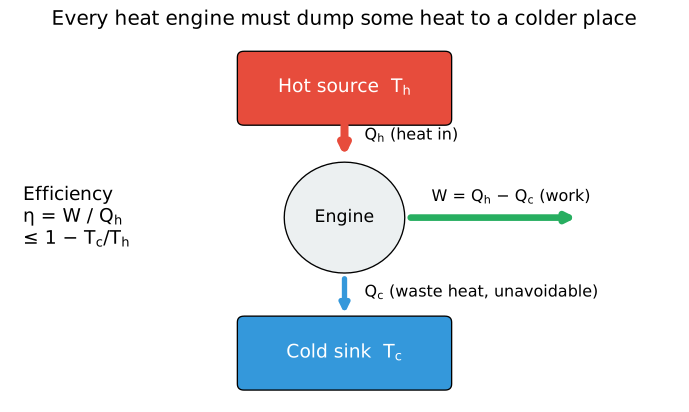
A practical consequence (Kelvin–Planck statement): no device can take heat from a single reservoir and turn it entirely into work. Some heat must be rejected to a colder place.
The Carnot limit
Sadi Carnot (1824) showed that the best possible engine operating between a hot reservoir at absolute temperature \(T_h\) and a cold one at \(T_c\) has efficiency
In words: the bigger the temperature ratio, the larger the fraction of heat that can become work. Temperatures must be in kelvin (K = °C + 273.15).
Worked example 2 — Carnot numbers
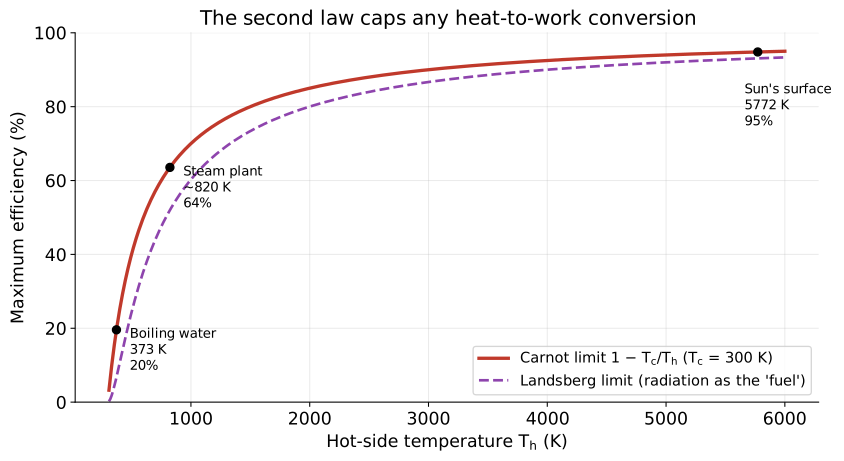
- Steam turbine, \(T_h = 823\) K (550 °C), \(T_c = 300\) K: \(\eta = 1 - 300/823 = 0.64\) (64 %). Real plants reach about 40–45 % (estimate) because of irreversibilities.
- Sun as the hot source, \(T_h = 5772\) K: \(\eta = 1 - 300/5772 = 0.948\) (≈95 %).
Is a solar cell a heat engine?
Not in the mechanical sense: a solar cell does not first turn light into heat and then heat into work. It converts photons directly into separated electrical charges (Unit 11). But thermodynamics still applies to it, because sunlight is radiation from a hot body and the cell sits at about 300 K:
- Landsberg limit (≈93 % for a 5772 K Sun and 300 K converter): the maximum work extractable from blackbody radiation, accounting for the entropy carried by the light itself. Formula: \(\eta_L = 1 - \tfrac{4}{3}\tfrac{T_c}{T_s} + \tfrac{1}{3}\left(\tfrac{T_c}{T_s}\right)^4\).
- Multi-junction ideal (infinite junctions): about 68.7 % under unconcentrated sunlight and about 86.8 % under maximum concentration (detailed-balance results quoted in standard texts, e.g., Green, Third Generation Photovoltaics; Nelson, The Physics of Solar Cells).
- Single junction (Shockley–Queisser, 1961): about 33.7 % at a band gap near 1.34 eV for AM1.5G — the limit you will compute in Unit 11.
The big drop from 93 % to 33.7 % is not a thermodynamic accident: it comes from using one band gap to absorb a broad spectrum (Unit 11). That gap is the single most important reason PV research chases tandems.
Worked example 3 — Landsberg
\(T_c/T_s = 300/5772 = 0.0520\). \(\eta_L = 1 - (4/3)(0.0520) + (1/3)(0.0520)^4 = 1 - 0.0693 + 0.0000024 \approx 0.931\) → 93.1 %.
Efficiency, carefully defined
Efficiency always means useful output ÷ total input, but the input must be stated:
| Efficiency | Input | Typical value |
|---|---|---|
| Cell efficiency (STC) | sunlight on the cell area | industrial TOPCon cells ≈ 25–26 % (estimate, ITRPV range) |
| Module efficiency (STC) | sunlight on the whole module area | TOPCon ≈ 23.5 %, PERC ≈ 21.7 % mass production (ITRPV 17) |
| SQ limit (silicon gap 1.12 eV) | AM1.5G, ideal cell | ≈ 33.4 % (computed in Unit 11) |
| Intrinsic Si limit (with Auger) | AM1.5G | 29.4 % (Richter et al., 2013) |
Module efficiency is lower than cell efficiency because the module area includes gaps between cells, the frame, and losses in glass, encapsulant and interconnects (SOL 304).
Common misconceptions
Misconceptions
- "With perfect materials a cell could reach 100 %." No: thermodynamics caps conversion of sunlight even with perfect materials (≈ 93 % Landsberg; ≈ 33.7 % for a single junction).
- "Waste heat is a design flaw that better engineering removes." Some heat is unavoidable (second law). Engineering can reduce excess losses, not the thermodynamic minimum.
- "Entropy just means disorder, so it doesn't matter for electronics." Entropy is why a cell's voltage is always below its band gap (Unit 11) and why hot cells make less voltage.
- "Carnot applies directly to PV." It bounds any conversion of heat at \(T_h\); for radiation the correct bound is Landsberg, and for a single gap, Shockley–Queisser.
What this means for manufacturing and the job
- Heat management shows up everywhere downstream: glass and encapsulant transparency, cell temperature coefficients (SOL 202/304), and hot-spot reliability (SOL 403).
- Process furnaces (diffusion, firing, crystal growth) are heat engines in reverse — energy balance thinking (first law) is the basis of the hot-zone modelling that SpaceX and Tesla crystal-growth roles mention (SOL 301).
- Record vs. limit vs. production: interviewers expect you to distinguish thermodynamic limits, material limits and practical production numbers.
Key equations
| Equation | Meaning |
|---|---|
| \(P_\text{abs} = P_\text{el} + P_\text{heat}\) | first law for a module |
| \(\eta_\text{C} = 1 - T_c/T_h\) | Carnot: max efficiency from heat at \(T_h\) |
| \(\eta_L = 1 - \tfrac43 x + \tfrac13 x^4\), \(x = T_c/T_s\) | Landsberg: max work from blackbody light |
Review questions
1. A geothermal plant has 180 °C steam and rejects heat at 30 °C. Carnot limit?
\(T_h = 453\) K, \(T_c = 303\) K → \(1 - 303/453 = 0.33\) (33 %).
2. Why must every heat engine reject some heat?
Turning heat into work lowers the entropy of the energy; the second law requires total entropy not to decrease, so some heat (carrying entropy) must be dumped into a colder reservoir.
3. A module absorbs 880 W/m² and produces 210 W/m². How much heat per m²?
880 − 210 = 670 W/m².
4. Order these from largest to smallest: Landsberg limit, SQ limit, Carnot limit for a 5772 K source, Si intrinsic limit.
Carnot (≈ 95 %) > Landsberg (≈ 93 %) > SQ (≈ 33.7 %) > Si intrinsic (29.4 %).
5. Why is module efficiency lower than cell efficiency?
Module area includes non-active area (cell gaps, borders, frame) and extra optical and resistive losses (glass reflection, encapsulant absorption, ribbons).
Sources
- Any standard thermodynamics text (e.g., Schroeder, An Introduction to Thermal Physics) for first/second law and Carnot.
- Landsberg & Tonge, J. Appl. Phys. 51, R1 (1980) — thermodynamic limits of solar conversion.
- Shockley & Queisser, J. Appl. Phys. 32, 510 (1961).
- Richter, Hermle & Glunz, IEEE J. Photovoltaics 3, 1184 (2013).
- ITRPV 17th ed. (2026) for production efficiencies.
- Infinite-junction limits as quoted in Green, Third Generation Photovoltaics (Springer, 2003) and Nelson (2003).