Unit 5 — Blackbody Radiation: Planck, Wien, Stefan–Boltzmann
Big idea. Every object glows with light whose spectrum depends on its temperature. An ideal absorber-emitter — a blackbody — follows Planck's law exactly. The Sun is close to a 5772 K blackbody, which is why sunlight peaks in the visible; your lamp filament is a ~2700–3200 K blackbody, which is why it is mostly infrared; and a solar cell at 300 K is itself a (very faint) infrared emitter — a fact that sets the ultimate efficiency limit.
Learning objectives
- State Planck's law in words and sketch blackbody curves for different temperatures.
- Use Wien's law to find peak wavelength and the Stefan–Boltzmann law to find total emitted power.
- Explain why the Sun's spectrum is approximately a 5772 K blackbody and where it deviates.
- Explain why incandescent/halogen lamps are poor solar simulators.
Why this matters
Blackbody physics underlies the solar spectrum (Unit 6–7), the Shockley–Queisser limit (Unit 11: the cell's own blackbody emission sets its dark current), infrared thermography of modules (SOL 401) and the furnace pyrometers used to control crystal growth and firing (SOL 301/302).
What is a blackbody?
A blackbody absorbs all light that hits it, at every wavelength. In thermal equilibrium it must also emit — and Kirchhoff's law says a good absorber at a wavelength is an equally good emitter at that wavelength. A blackbody therefore emits the maximum possible thermal radiation at each wavelength for its temperature. Real objects have an emissivity \(\varepsilon(\lambda) \le 1\) that scales this ideal.
Planck's law
Planck's law gives the spectral radiance (power per area per solid angle per wavelength):
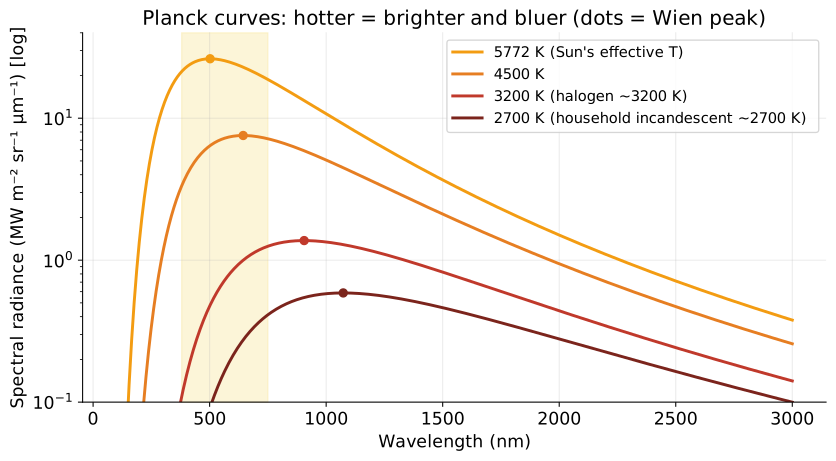
where \(k_B = 1.381 \times 10^{-23}\) J/K is Boltzmann's constant. In words: at short wavelengths the exponential kills the emission (photons are too "expensive" for the available thermal energy); at long wavelengths emission falls as fewer modes carry energy; in between there is a peak whose position and height depend only on temperature.
Wien's displacement law
The peak wavelength is inversely proportional to temperature:
Worked example 1 — where do things peak?
- Sun, 5772 K: \(\lambda_\text{max} = 2.898\times10^{-3}/5772 = 502\) nm (green-blue).
- Halogen filament, 3200 K: 906 nm (infrared!).
- Household bulb, 2700 K: 1073 nm.
- Solar module at 300 K: 9.66 µm (thermal infrared — what a thermal camera sees).
(The peak position depends on whether you plot per unit wavelength or per unit frequency; Wien's law in the form above is for the per-wavelength plot used here.)
Stefan–Boltzmann law
Integrating Planck's law over all wavelengths and directions gives the total power emitted per unit area:
In words: emitted power rises as the fourth power of absolute temperature — double the temperature, sixteen times the power.
Worked example 2 — the Sun's surface and a module's back
- Sun's surface: \(M = 5.670\times10^{-8} \times 5772^4 = 6.29 \times 10^7\) W/m² — 63 MW from every square metre.
- A module at 60 °C (333 K) with emissivity 0.85 (glass is a good IR emitter; estimate): \(M = 0.85 \times 5.670\times10^{-8} \times 333^4 \approx 590\) W/m² per face. It also absorbs IR from its surroundings, so the net radiative cooling is the difference — typically a few hundred W/m² for a hot module under a clear sky (estimate). Radiation and convection together shed the ~700 W/m² of heat from Unit 2.
The Sun as a blackbody
The Sun's effective temperature is defined as the temperature of a blackbody of the same size radiating the same total power: \(T_\text{eff} = 5772\) K (IAU 2015 nominal value). Spread over the sphere of Earth's orbit, that blackbody gives the solar constant you will derive in Unit 6.
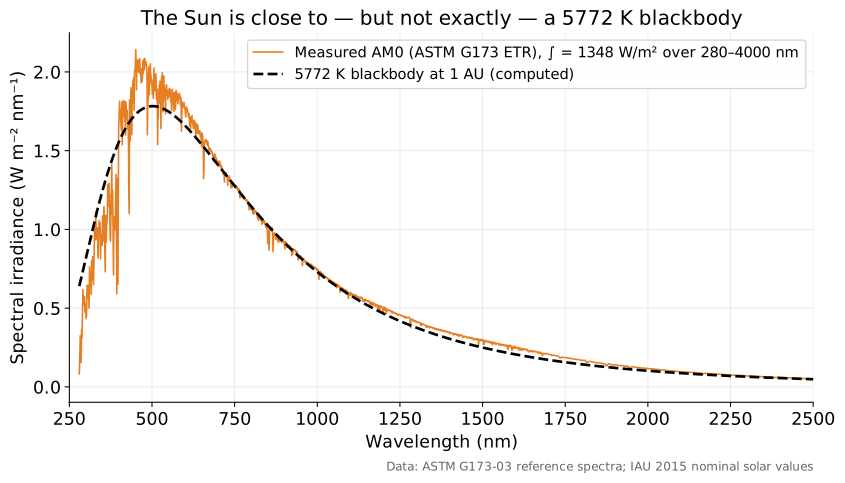
Why not exact? The light we see comes from a range of depths and temperatures in the solar photosphere; cooler upper layers absorb specific wavelengths (Fraunhofer lines) and the disc is darker at its edge (limb darkening). For PV design the measured spectrum is always used; the blackbody is for understanding and for theoretical limits.
Lamps as blackbodies
A tungsten filament is a reasonable greybody (emissivity ~0.3–0.45 in the visible; estimate). At 2700–3200 K most of its output is infrared, so incandescent and halogen lamps are poor stand-ins for sunlight: too little blue, too much IR. Professional solar simulators use xenon arc lamps or LED arrays with filters, and are graded for spectral match (IEC 60904-9; SOL 401). In Lab 101-C you will estimate filament temperature from its electrical resistance and see the colour shift with your own eyes.
Worked example 3 — filament temperature from resistance (Lab 101-C preview)
Tungsten's resistance rises with temperature; tabulated resistivity data (CRC Handbook) are approximated over 300–3000 K by \(R/R_{300} \approx (T/300)^{1.2}\) (fit; estimate within ~10 %). A 12 V bulb measures 2.0 Ω cold (300 K) and 28 Ω at full voltage: ratio 14 → \(T \approx 300 \times 14^{1/1.2} = 300 \times 9.0 \approx 2700\) K. Wien peak ≈ 1.07 µm.
The cell is a blackbody too
A solar cell at 300 K emits a little thermal radiation, and — crucially — a cell under voltage emits extra light near its band gap (this is electroluminescence, used to image cells in SOL 401). Shockley and Queisser realised that a perfect cell's minimum dark current is set by this emission: whatever can absorb must also emit. That is the "detailed balance" at the heart of the efficiency limit in Unit 11.
Common misconceptions
Misconceptions
- "Black means it emits nothing." Black objects are the best emitters (Kirchhoff).
- "The Sun is yellow, so it peaks in yellow." It peaks near 500 nm per-wavelength and is essentially white; it looks yellow through the atmosphere because blue is scattered out (Unit 7).
- "A halogen lamp is a good test light for solar cells." It is far too red/IR-heavy; cells tested under it read differently from sunlight.
- "Only hot things radiate." Everything above 0 K radiates; room-temperature objects peak near 10 µm.
What this means for manufacturing and the job
- Pyrometers and IR cameras measure temperature from thermal emission in Cz pullers, firing furnaces and module hot-spot inspection (SOL 301, 302, 401, 403).
- Sun-simulator lamps and their spectral classes are blackbody/non-blackbody engineering (SOL 401).
- Electroluminescence imaging — a standard factory inspection — is the cell emitting light because absorption and emission are linked (SOL 401).
Key equations
| Equation | In words |
|---|---|
| \(B_\lambda(T) = \dfrac{2hc^2}{\lambda^5}\dfrac{1}{e^{hc/\lambda k_BT}-1}\) | Planck: spectrum of thermal emission |
| \(\lambda_\text{max} = 2.898\times10^{-3}/T\) | Wien: hotter → bluer peak |
| \(M = \varepsilon\sigma T^4\) | Stefan–Boltzmann: total emission ∝ T⁴ |
Review questions
1. Peak wavelength of a 1500 K furnace wall?
2.898 × 10⁻³ / 1500 = 1.93 µm.
2. By what factor does total emission rise from 300 K to 600 K?
(600/300)⁴ = 16.
3. Why is a 3000 K lamp a poor solar simulator?
Its Planck curve peaks near 970 nm, so it has much more IR and much less blue than sunlight; a cell's response to it does not represent sunlight.
4. What is Kirchhoff's law, and why does it matter for solar cells?
At each wavelength, absorptivity = emissivity in equilibrium. A cell that absorbs above its gap must also emit there, which sets its minimum recombination current and therefore its maximum voltage.
5. Compute the Sun's surface emission per m² for T = 5772 K.
σT⁴ = 5.670 × 10⁻⁸ × (5772)⁴ ≈ 6.29 × 10⁷ W/m².
Sources
- PVEducation, "Blackbody Radiation" and "The Sun" pages.
- IAU 2015 Resolution B3 (nominal solar values: \(T_\text{eff}\) = 5772 K, \(R_\odot\) = 6.957 × 10⁸ m).
- CODATA 2018 for σ, \(k_B\), Wien constant.
- Tungsten resistivity vs temperature: CRC Handbook of Chemistry and Physics (tabulated); the power-law fit is an approximation made here.
- Shockley & Queisser (1961) for detailed balance.