Unit 11 — Safety and Handling of Process Chemicals and Gases
Big idea. Solar-cell factories use some of the most dangerous chemicals in industry: pyrophoric silane, highly toxic phosphine and diborane, hydrofluoric acid, corrosive POCl₃ and BBr₃, hot caustic baths that release hydrogen, and greenhouse-potent NF₃. They are used safely every day through engineering controls first, procedures second, PPE last. This unit is awareness-level: it teaches you to recognise the hazards, read safety data, and understand how fabs are engineered — not to handle these materials at home (they are lecture-only in this curriculum).
Learning objectives
- Name the main hazardous gases and chemicals in PV manufacturing and their dominant hazard.
- Read a Safety Data Sheet (SDS) and GHS pictograms; interpret PEL, REL, TLV and IDLH.
- Apply the hierarchy of controls to a PV process.
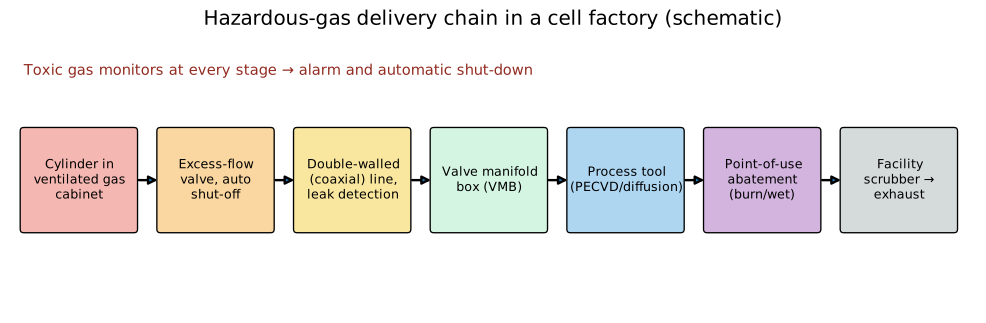
- Describe a hazardous-gas delivery chain (gas cabinet → abatement).
- Explain cleanroom and contamination-control basics.
- Know the special first-aid requirement for HF.
Why this matters
Hazardous-gas and chemical safety appears in 13 of 31 analysed Tesla/SpaceX solar postings, contamination/cleanroom practice in 12 — the most-requested items after cell-process knowledge (01-job-requirements.md). Interviewers expect you to speak the language even for non-safety roles.
Hazard classes
| Hazard class | Meaning | PV examples |
|---|---|---|
| Pyrophoric | ignites spontaneously in air | silane (SiH₄), trimethylaluminium (TMA, ALD precursor) |
| Flammable | burns with an ignition source | hydrogen (from texturing; process gas; 4–75 % flammable range in air), IPA, ammonia (narrow range) |
| Acutely toxic | harmful/lethal at low exposure | phosphine (PH₃), diborane (B₂H₆), arsine (III–V), HF |
| Corrosive | destroys tissue and materials | HF, HNO₃, HCl, KOH/NaOH, POCl₃, BBr₃/BCl₃ (water-reactive → HCl/HBr) |
| Oxidiser | intensifies fire | HNO₃, H₂O₂, O₃, N₂O, NF₃ |
| Asphyxiant | displaces oxygen | N₂, Ar, He (large quantities indoors) |
| Environmental | climate/aquatic harm | NF₃, SF₆, CF₄ (very high global-warming potential); Cd and Pb compounds |
Reading exposure limits
- PEL (OSHA Permissible Exposure Limit): legally enforceable 8-hour time-weighted average (TWA) in the US.
- REL (NIOSH Recommended Exposure Limit) and TLV (ACGIH Threshold Limit Value): recommended limits, often stricter.
- IDLH: Immediately Dangerous to Life or Health — escape-only concentration.
| Substance | Key hazard | OSHA PEL (TWA) | NIOSH IDLH |
|---|---|---|---|
| Phosphine PH₃ | highly toxic gas | 0.3 ppm | 50 ppm |
| Diborane B₂H₆ | highly toxic, pyrophoric | 0.1 ppm | 15 ppm |
| Silane SiH₄ | pyrophoric (fire/explosion) | none (NIOSH REL 5 ppm) | — |
| Hydrogen fluoride HF | corrosive, systemic toxin | 3 ppm | 30 ppm |
| Hydrogen chloride HCl | corrosive | 5 ppm (ceiling) | 50 ppm |
| Ammonia NH₃ | corrosive/toxic | 50 ppm | 300 ppm |
| Nitrogen trifluoride NF₃ | toxic oxidiser; GWP > 16,000 | 10 ppm | 1000 ppm |
Values as listed in the NIOSH Pocket Guide to Chemical Hazards (recalled for this course; verify against the current Pocket Guide/SDS before relying on them). GWP for NF₃ per IPCC AR5 (100-year ≈ 16,100).
Silane: the signature PV hazard
Silane is the feedstock for PECVD SiNₓ and a-Si:H. It is pyrophoric: a leak may ignite immediately — or, worse, accumulate and ignite with a delayed explosion. Fabs store it in exhausted gas cabinets or outdoor bulk systems with excess-flow valves, purge panels, and automatic shut-off on flame or gas detection; lines are welded and leak-tested; and unreacted silane from tools is burned or scrubbed in point-of-use abatement.
HF: why it's different
Hydrofluoric acid is chemically a weak acid, so skin contact may not hurt at first. The fluoride ion penetrates deep into tissue and binds calcium and magnesium, causing deep burns, bone damage and potentially fatal hypocalcaemia (and cardiac arrhythmia) even from modest skin areas of concentrated acid. Facilities using HF keep calcium gluconate gel (2.5 %) at hand for immediate first aid after flushing with water, and require specialised PPE (face shield, HF-rated gloves, apron). This is why every HF process in this curriculum is lecture-only.
Liquids in the cell line
- POCl₃ / BBr₃ / BCl₃ (diffusion sources): corrosive; react violently with water to release HCl/HBr fumes. Handled in sealed bubblers within exhausted cabinets.
- KOH/NaOH texturing: hot caustic splash → severe eye damage; produces hydrogen (Unit 8 example: ~1 L per wafer).
- HNO₃/HF mixtures: toxic NOₓ fumes plus HF hazard.
- H₂O₂, O₃: oxidisers in cleans.
- TMA (ALD): pyrophoric liquid.
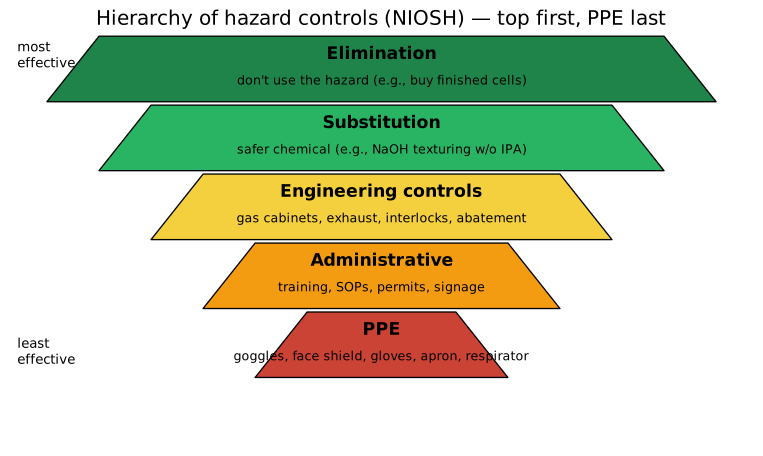
The hierarchy of controls
Hazardous-gas delivery chain
Relevant codes and guidelines (for orientation): SEMI S2 (EHS guideline for semiconductor equipment), NFPA 318 (protection of semiconductor fabrication facilities), OSHA Hazard Communication (29 CFR 1910.1200 — SDS and labels), Process Safety Management where thresholds apply, and lockout/tagout (29 CFR 1910.147) for equipment maintenance.
Reading an SDS
Every hazardous chemical comes with a 16-section Safety Data Sheet (GHS format). The sections you will use most: 2 (hazards, pictograms, H- and P-statements), 4 (first aid), 7 (handling and storage), 8 (exposure limits and PPE), 10 (reactivity/incompatibilities — e.g., POCl₃ + water), 13 (disposal). Practise on the SDS for copper sulfate and potassium alum before Lab 102-A.
Cleanroom and contamination control
Cleanrooms limit particles by filtered laminar airflow and gowning; ISO 14644-1 classes rate particle counts per m³. For solar cells, metal and organic contamination matter as much as particles (Unit 5, Unit 7): metal-free wafer carriers, dedicated tweezers, gloves changed regularly, high-purity chemicals and DI water, and segregating "dirty" (pre-clean) and "clean" (pre-furnace) areas. Solar fabs typically run at less stringent particle classes than IC fabs, but with strict chemical cleanliness.
Common misconceptions
Misconceptions
- "PPE is the main protection." It's the last line; engineering controls do most of the work.
- "No smell, no danger." Many toxic gases are dangerous below odour thresholds, or deaden the sense of smell; rely on monitors.
- "HF is a weak acid, so it's mild." It is one of the most dangerous lab chemicals (deep tissue and systemic toxicity).
- "Silane leaks always catch fire immediately." Delayed ignition of accumulated silane is a known explosion hazard.
What this means for manufacturing and the job
- Expect gas-cabinet training, HF and chemical-handling training, lockout/tagout and emergency-response drills in any cell or module plant role.
- Process engineers write SOPs, risk assessments (e.g., FMEA) and change-control documents that include EHS review (SOL 402).
- Certifications such as SEMI S2 assessment or CSP are specialist safety credentials outside this curriculum.
Review questions
1. Which hazard class fits silane, and what is its most dangerous failure mode?
Pyrophoric; delayed ignition/explosion after a leak accumulates.
2. What special first aid is required after HF skin exposure?
Flush with water and apply 2.5 % calcium gluconate gel immediately; seek emergency medical care.
3. Put in order of preference: respirator, gas cabinet with exhaust, SOP training, replacing the chemical.
Replace (substitution) → gas cabinet (engineering) → SOP training (administrative) → respirator (PPE).
4. What does IDLH mean?
Immediately Dangerous to Life or Health — the concentration from which escape must be possible without irreversible harm; used for respirator selection and emergency planning.
5. Why do cell lines worry about metal contamination more than particle counts?
Metals at ppb–ppt levels diffuse quickly at process temperatures and create deep-level defects that kill lifetime and efficiency.
Sources
- NIOSH Pocket Guide to Chemical Hazards (cdc.gov/niosh/npg) — exposure limits (verify current values).
- NIOSH, "Hierarchy of Controls".
- OSHA 29 CFR 1910.1200 (HazCom), 1910.147 (LOTO).
- SEMI S2; NFPA 318 — named for orientation, not opened.
- IPCC AR5 WG1, ch. 8, Table 8.A.1 — GWP of NF₃.
- ISO 14644-1 — cleanroom classes (named).
- Honeywell/industry HF medical guidance (calcium gluconate first aid) — widely published.